Eight in ten workers have already been quiet hired, according to a Monster poll. Yet only 24% of organizations have formal internal mobility programs (LinkedIn Workplace Learning Report, 2025). That gap tells the whole story. Most quiet hiring happens reactively, without structure, communication, or fair compensation adjustments.
The result? Some employees get genuine growth opportunities. Others get extra work with no upside. The difference comes down entirely to execution. This guide breaks down what quiet hiring actually means, when it works, when it backfires, and how to build a structured quiet hiring process that closes skills gaps without burning out your people.
Key Takeaways
- Quiet hiring fills roles through internal redeployment, upskilling, or short-term contractors rather than new full-time hires.
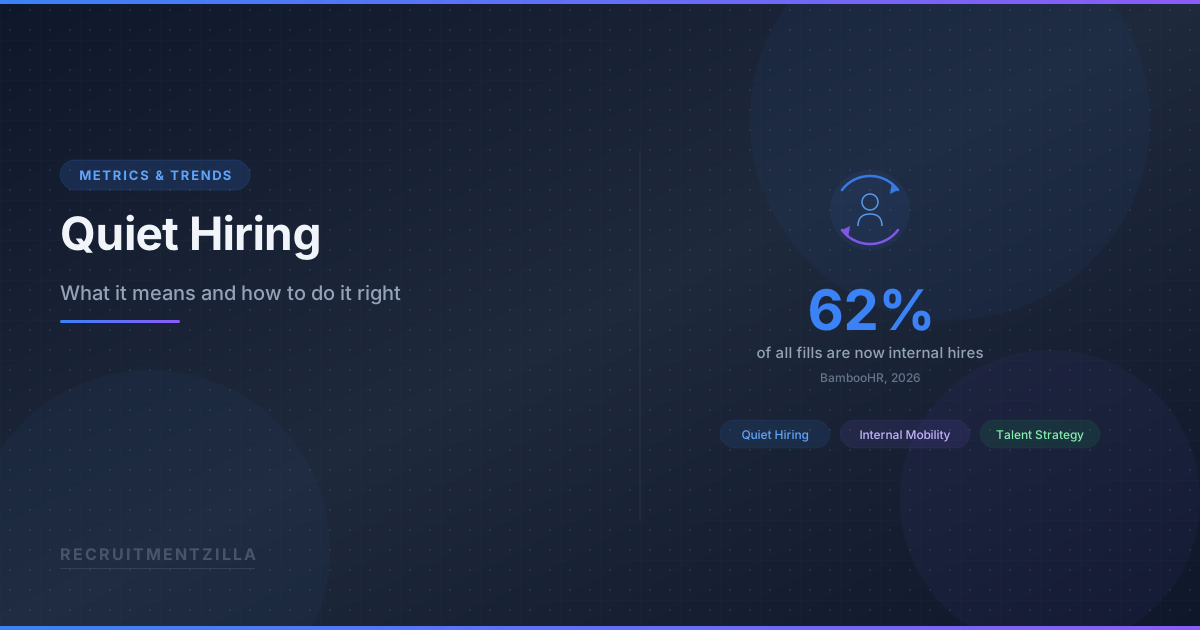
- Internal mobility now accounts for 62% of all fills (BambooHR, 2026).
- Done right, it cuts cost-per-hire by 60% and time-to-fill from 42 days to under 15.
- Done wrong, 27% of workers would consider quitting.
- Success requires skills audits, transparent communication, compensation reviews, and clear timelines.
What Is Quiet Hiring?
Quiet hiring is when an organization fills critical roles or acquires new skills without adding full-time headcount. Gartner’s Emily Rose McRae defined the concept as acquiring “new skills without actually hiring new full-time employees.” The practice takes three distinct forms, and understanding each one matters for getting the execution right.
The first form is internal redeployment. A company reassigns an employee from one team or role to another where the need is more urgent. The second is role expansion, where employees take on additional responsibilities within their current position. The third involves bringing on contractors, freelancers, or gig workers for specialized, short-term needs. All three qualify as quiet hiring, but each carries different implications for the people involved.
Here’s what quiet hiring is not: simply piling more work on someone’s desk. When done well, the process includes skill development planning, clear role definitions, and a compensation review. Gartner originally coined the term as a top workplace trend for 2023, during a period when recession fears made companies cautious about growing headcount. Since then, it’s evolved from a cost-cutting response into a deliberate talent management strategy.
Consider a well-known example. During severe labor shortages, Qantas asked executives to rotate into operational roles, including baggage handling, to keep flights running. That’s quiet hiring at its most visible, but most instances are far less dramatic. They look like a marketing coordinator picking up content strategy responsibilities, or a data analyst covering business intelligence work for another department.
The critical distinction comes down to intent and support. A stretch assignment with training, timeline, and compensation review is a development opportunity. The same assignment without any of those elements is just extra work. Understanding how talent acquisition differs from traditional recruitment can help you see where quiet hiring fits into your broader hiring strategy.
Quiet hiring is an organizational strategy where companies fill critical skill gaps by redeploying existing employees, expanding current roles, or hiring short-term contractors instead of adding permanent headcount. Gartner identified it as a top workplace trend in 2023, and by 2026, internal mobility accounts for 62% of all fills (BambooHR, 2026).
Why Are Companies Quiet Hiring in 2026?
Internal mobility now accounts for 62% of all fills, up from 51% in 2021 (BambooHR State of Hiring, 2026). That steady climb reflects a structural shift in how organizations close talent gaps, not a temporary pandemic-era reaction.
Several forces are driving this change at once. The U.S. hiring rate sits at 3.3% while the firing rate holds at 1.1% (St. Louis Fed, 2025), which means companies are cautious about adding headcount but reluctant to let people go. In that environment, making better use of existing talent becomes the default response. And the cost math is compelling: internal hires cost roughly 60% less than external ones and fill about 30 days faster (SHRM/Recruiterflow, 2025).
The looming talent shortage adds urgency. Korn Ferry projects that 85 million jobs could go unfilled by 2030, resulting in $8.5 trillion in unrealized annual revenue. When you can’t find the people you need externally, you develop the people you already have. That’s the logic behind Gartner’s prediction that HR will redirect one-third of its recruiting capacity inward in 2026.
But is cost reduction really the primary motivator? For most companies, no. The skills gap is.
The Skills Gap Is the Real Driver
The numbers here are stark. According to McKinsey, 87% of companies worldwide either already have a skills gap or expect one within a few years (2024). The World Economic Forum’s Future of Jobs Report (2025) projects that 59 out of every 100 workers will need reskilling by 2030, with 39% of core skills expected to change entirely.
In response, 85% of employers plan to prioritize upskilling their workforce, and 50% plan to transition staff from declining roles into growing ones (WEF, 2025). Quiet hiring isn’t just a hiring tactic in this context. It’s a development strategy that treats your existing workforce as your primary talent pipeline.
For companies approaching this from a broader planning perspective, workforce planning strategies for growing companies provides a useful framework for thinking about where internal mobility fits within your overall talent roadmap.
Companies are quiet hiring because internal mobility now fills 62% of all roles, up from 51% in 2021 (BambooHR, 2026). With 87% of companies facing skills gaps (McKinsey, 2024) and internal hires costing 60% less than external ones, redirecting talent internally is both faster and cheaper.
What Are the Benefits of Quiet Hiring?
Companies with strong learning cultures see 57% higher retention and 23% higher internal mobility compared to baseline (LinkedIn Workplace Learning Report, 2025). Those numbers reveal why quiet hiring, when backed by real development investment, produces measurable advantages beyond simple cost savings.
The financial case is straightforward. The average external cost-per-hire runs approximately $4,700, while an internal transition costs roughly $1,920 (SHRM/Recruiterflow, 2025). That’s about 60% less. Time-to-fill drops even more dramatically: 42 days for an external hire versus 10-15 days for an internal move. When you’re trying to fill a critical role that’s blocking a project or revenue, those 30 extra days matter.
Speed isn’t the only benefit, though. Internal hires already understand company culture, processes, and relationships. They don’t need weeks of onboarding to figure out how decisions get made or who to call when something breaks. That institutional knowledge translates directly to faster time-to-productivity.
From the employee side, 63% of workers view quiet hiring as an opportunity to learn new skills (Monster, 2023). When organizations pair reassignment with genuine skill development, they create a cycle where employees grow, retention improves, and the company builds deeper bench strength. That’s a very different outcome than what happens when quiet hiring is handled poorly.
For organizations weighing whether to fill roles internally or go to market, a cost-benefit analysis of recruitment agency vs in-house hiring can help quantify the tradeoffs.
Quiet hiring saves companies roughly 60% on cost-per-hire and cuts time-to-fill from 42 days to under 15. Organizations with strong internal mobility programs see 57% higher retention and 23% more internal promotions (LinkedIn Workplace Learning Report, 2025).
What Are the Risks of Quiet Hiring Done Wrong?
A Monster poll found that 27% of workers would consider quitting if quiet hired, while 41% would perceive their company as disorganized (Monster, 2023). Those numbers jump when quiet hiring happens without communication, compensation adjustment, or role clarity.
The burnout risk is real and measurable. According to SHRM’s 2025 State of the Workplace report, 44% of U.S. employees already feel burned out, 45% feel emotionally drained, and 51% feel used up at the end of each workday. Adding new responsibilities to people who are already stretched thin doesn’t solve a skills gap. It creates a retention crisis.
Skills mismatch compounds the problem. Half of quiet-hired workers said their new roles didn’t align with their skill set (Monster, 2023). That means the reassignment fails to close the skills gap and simultaneously frustrates the employee, a lose-lose outcome.
Meanwhile, only 20% of employees globally are engaged at work (Gallup State of the Global Workplace, 2026). Poor execution of quiet hiring pushes more people into that disengaged majority. And 36% of workers already report heavier workloads from unfilled positions (SHRM, 2025).
Legal exposure adds another layer of risk. Reassigning employees can trigger FLSA concerns if exempt and non-exempt classifications change. Role modifications may affect ADA accommodations if essential job functions shift. And for employees under employment contracts, changes to duties or compensation may require written consent. These aren’t hypothetical risks. They’re compliance requirements that HR teams need to document carefully.
The Burnout Trap
I’ve seen quiet hiring go sideways when managers frame it as “we need you to cover this” instead of “here’s a development opportunity we’ve designed for you.” The difference in employee response is night and day. Without proper communication and compensation adjustment, quiet hiring becomes unpaid extra work. The line between a “stretch assignment” and exploitation depends entirely on how the move is structured, communicated, and supported.
If you’re wrestling with how to maintain a positive experience during organizational changes, finding the right balance between efficiency and employee experience offers practical guidance on managing that tension.
Poorly executed quiet hiring backfires. A Monster poll found 27% of workers would consider quitting if reassigned, while 50% said new roles didn’t match their skills (Monster, 2023). With 44% of U.S. employees already burned out (SHRM, 2025), adding uncompensated responsibilities accelerates attrition.
How Do You Implement Quiet Hiring the Right Way?
Only 24% of organizations have structured internal mobility programs (LinkedIn Workplace Learning Report, 2025). That means most quiet hiring happens ad hoc, and that’s where the problems start. Here’s a seven-step framework for making it systematic.
Step 1: Audit your skills inventory. Before reassigning anyone, map your current employee skills against organizational gaps. You can’t make smart moves if you don’t know what capabilities you already have. Keep skills data current. Outdated inventories lead to mismatches, which is exactly how you end up with 50% of quiet-hired workers in roles that don’t fit their abilities.
Step 2: Identify high-potential internal candidates. Look for employees who’ve expressed interest in growth, have transferable skills, or show signs of disengagement in their current roles. Sometimes the best candidate for a stretch assignment is someone who’s bored, not someone who’s already overloaded.
Step 3: Communicate transparently. Explain why the move is happening, what it means for their career path, and what support they’ll receive. Gartner’s Emily Rose McRae emphasizes that the success of quiet hiring rests in how it’s framed to employees. A “we need you to cover this” conversation produces very different results than “we see your potential and want to invest in your growth.” Having an open door policy that supports transparent communication makes these conversations far more natural when the groundwork already exists.
Step 4: Adjust compensation and title. If responsibilities expand significantly, compensation must follow. Avoid “dry promotions,” which means more work at the same pay. These destroy trust faster than almost anything else in the employment relationship.
Step 5: Set clear timelines and success metrics. Define whether the assignment is temporary (with a specific end date) or permanent. Establish measurable outcomes so both sides know what success looks like. Ambiguity breeds resentment.
Step 6: Provide training and support. With 85% of employers planning to prioritize upskilling (WEF, 2025), budget for learning, mentoring, and ramp-up time. Throwing someone into a new role without preparation isn’t development. It’s negligence.
Step 7: Backfill or redistribute the vacated workload. This is the most overlooked step. The most common mistake I see is moving your best performer out of a team without redistributing their work. You create two problems instead of solving one: the original team is now understaffed, and the redeployed employee carries guilt about the people they left behind.
Communication Templates That Work
For manager-to-employee conversations, lead with career benefit before business need. Explain what skill development the employee will gain, what support the company will provide, and what the timeline looks like. Put it in writing.
For team announcements, address workload redistribution directly. Remaining team members need to hear how the departing employee’s responsibilities will be covered, not just that someone is moving to a new opportunity.
Always document role changes formally. Update the job description, confirm compensation adjustments, set a review date, and define success criteria. Verbal agreements aren’t enough. When the move happens to go poorly, written documentation protects both the employee and the organization.
For situations where external hiring makes more strategic sense, explore when direct hire beats other staffing approaches to compare options.
Effective quiet hiring follows a structured process: audit skills, identify candidates, communicate transparently, adjust compensation, set timelines, provide training, and backfill vacated roles. Only 24% of organizations have formal internal mobility programs (LinkedIn, 2025), leaving most quiet hiring reactive and risky.
How Should You Communicate Quiet Hiring to Employees?
HR consultant Matthew Burr notes that “companies are being much more strategic about not adding headcount” (Monster, 2023). Strategy without communication, however, breeds resentment. How you tell people about a reassignment determines whether they see it as an opportunity or an insult.
The data supports this. When quiet hiring is framed as skill development, 63% of workers view it positively (Monster, 2023). That’s a strong majority. But the framing has to be genuine, not performative. Employees can tell when “development opportunity” is code for “we can’t afford to hire someone.”
Frame the change in terms of the employee’s career trajectory, not just the company’s immediate need. Be specific about what they’ll learn, what support they’ll receive, and how this move positions them for future growth. Vague promises don’t work. Concrete plans do.
Provide written documentation for every reassignment. This includes an updated job description, any compensation adjustments, the timeline (temporary or permanent), and clear success criteria. This protects both sides and reduces the ambiguity that feeds anxiety.
The biggest communication mistake I see is announcing quiet hiring moves in group settings. These conversations must happen one-on-one first, with the employee having time to process before any team announcement. Nobody wants to learn about a major role change at the same time as twenty colleagues.
Don’t forget the team left behind. When someone moves to a new role, their former teammates need to understand how the workload will be redistributed. Otherwise, they’re left wondering if they’re next, or worse, silently absorbing extra work without acknowledgment.
As Mark Marone, PhD, writes for Harvard Business Impact, “The real way to quiet hire starts with your frontline leaders.” Managers are the ones having these conversations, so they need coaching on how to frame reassignments, respond to pushback, and provide ongoing support during the first 30-60-90 days of a transition.
Successful quiet hiring depends on transparent communication. Research shows 63% of employees view reassignment positively when framed as a skill development opportunity (Monster, 2023). Written documentation, compensation review, and regular 30-60-90-day check-ins prevent the resentment that drives 27% of quietly hired workers to consider quitting.
What Skills Should You Prioritize When Quiet Hiring?
The World Economic Forum projects that 39% of workers’ core skills will change by 2030 (WEF Future of Jobs Report, 2025). That projection makes skills-based quiet hiring essential rather than simply moving warm bodies to fill empty seats.
Start by mapping skills gaps to business-critical functions. Not every gap justifies internal redeployment. A temporary gap in a support function might be better served by a contractor, while a persistent gap in a revenue-generating function calls for a more permanent internal move.
Prioritize adjacent skills over dramatic role changes. Moving a data analyst into data science work makes sense because the foundational skills overlap. Moving an accountant into software development doesn’t. The closer the skills match, the shorter the ramp-up time and the higher the success rate. Remember, 50% of quiet-hired workers reported that their new roles didn’t match their skills (Monster, 2023). Skills assessments before reassignment, not after, prevent that outcome.
Bank of America provides a compelling case study. The company moved from 30% internal promotions to 50% by adopting a skills-first approach (HBR, 2025). That improvement came from systematically identifying transferable skills rather than relying on job titles or organizational charts.
Building a Skills Inventory for Quiet Hiring
A practical skills inventory involves four steps. First, survey current competencies across teams using a standardized framework. Second, identify emerging skill requirements from your business strategy and market trends. Third, map transferable skills across departments to find hidden matches. Fourth, tag employees who’ve expressed development interests, either through performance reviews, engagement surveys, or informal conversations.
Build a skills taxonomy that categorizes each competency as current (fully proficient), adjacent (related and developable within 3-6 months), or aspirational (requires significant training). This taxonomy becomes your quiet hiring playbook, helping you match the right people to the right opportunities.
For organizations building formal internal mobility programs, how talent marketplaces help companies match skills to roles provides additional guidance on the technology side of skills matching.
Skills-based quiet hiring outperforms role-based reassignment. Bank of America increased internal promotions from 30% to 50% with a skills-first strategy (HBR, 2025). The WEF projects 39% of core skills will change by 2030, making continuous skills mapping a prerequisite for effective internal redeployment.
How Do You Measure Quiet Hiring Success?
With internal mobility at 62% of fills (BambooHR, 2026) but global engagement at a decade low of just 20% (Gallup, 2026), measuring outcomes isn’t optional. Without clear metrics, you can’t tell whether your quiet hiring program is developing talent or just shuffling deck chairs.
Here are the seven metrics that matter most.
Internal fill rate. Track the percentage of roles filled internally versus externally. BambooHR’s 62% benchmark gives you a reference point, but the right ratio depends on your industry and growth stage. A fast-growing startup will naturally lean more external than a stable enterprise.
Time-to-productivity. How quickly do redeployed employees reach full performance? This should be faster than the 42-day average for external hires. If it’s not, your skills matching or training support needs work.
Retention of quiet-hired employees. Compare turnover rates of reassigned versus non-reassigned workers at 6 and 12 months. If reassigned employees are leaving at higher rates, you’ve got an execution problem.
Employee satisfaction scores. Survey quiet-hired employees specifically on role fit, support received, and perceived career impact. Generic engagement surveys won’t capture this. You need targeted questions about the reassignment experience.
Skills gap closure rate. Measure the reduction in identified skill gaps quarter-over-quarter. If you started with 15 critical skill gaps and six months of quiet hiring has only closed two, the approach may not be working for those particular needs.
Cost savings. Compare the total cost of internal redeployment (training, transition time, any compensation adjustment) against the hypothetical cost of an external hire for the same role. The SHRM data suggests you should see roughly 60% savings, but your actual numbers will vary.
Backfill impact. Monitor performance and satisfaction of teams from which employees were redeployed. This is the metric most organizations forget, and it’s often where quiet hiring creates its biggest hidden cost.
For a broader view of how to track the effectiveness of your talent operations, recruiter productivity metrics worth tracking covers additional KPIs relevant to both internal and external hiring.
Measure quiet hiring success through internal fill rate, time-to-productivity, retention of reassigned employees, satisfaction surveys, skills gap closure rate, and cost savings versus external hiring. Without measurement, organizations cannot distinguish strategic talent redeployment from chaotic reshuffling.
Frequently Asked Questions
Is quiet hiring legal?
Yes, employers generally have the right to reassign employees. But FLSA classification changes, ADA accommodation impacts, and employment contract modifications require careful review. If a reassignment substantially changes essential job functions or compensation structure, consult legal counsel. For more on compliance considerations during role changes, see our guide to EEOC compliance in hiring.
What is the difference between quiet hiring and quiet quitting?
Quiet quitting is when employees do the minimum required. Quiet hiring is when employers fill gaps without adding headcount. They’re opposite sides of the same engagement problem. Only 20% of employees globally are engaged at work (Gallup, 2026), which means both phenomena are symptoms of a deeper disconnect between employers and their workforce. For a comprehensive framework on doing more with less through workforce optimization, see our dedicated guide.
Should you pay employees more when quiet hiring?
If responsibilities expand significantly beyond the original job description, adjust compensation accordingly. “Dry promotions,” where employees take on more work at the same pay, damage trust and accelerate turnover. For context on pay-related legal considerations, read about salary history bans and pay transparency.
How long should a quiet hiring assignment last?
Set clear timelines from the start. Temporary assignments work well at 3-6 months with a defined end date. Permanent transitions should include a formal title change, compensation review, and updated job description within 90 days. Open-ended assignments with no timeline create uncertainty and breed disengagement.
Can quiet hiring replace external recruiting entirely?
No. Quiet hiring fills short-term gaps and develops existing talent, but organizations still need external hiring for specialized skills, fresh perspectives, and growth beyond current headcount. Internal mobility fills 62% of roles (BambooHR, 2026). The remaining 38% exists for a reason.
Conclusion
Quiet hiring isn’t a trend. It’s a structural shift in how organizations fill roles, with 62% of all positions now filled internally. The companies that do it well treat it as a development strategy: structured process, transparent communication, fair compensation, and measurable outcomes. The companies that do it poorly just pile more work on people who are already stretched thin.
The difference between those two outcomes is execution. Start by auditing your current skills inventory. Identify three roles this quarter that could realistically be filled through internal redeployment. Use the seven-step framework in this guide to structure each move with proper communication, compensation review, and timeline. Then measure the results and iterate.
Your existing team already has more capability than most organizations realize. The question isn’t whether you’ll do quiet hiring. You’re almost certainly already doing it. The question is whether you’ll do it with intention.