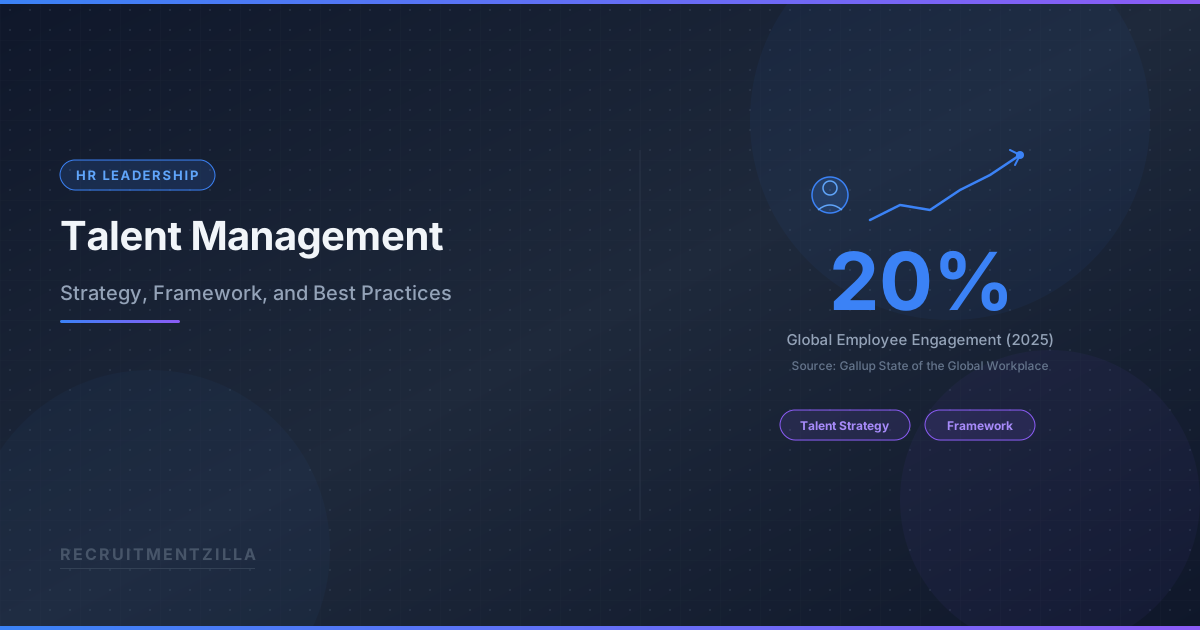
Global employee engagement fell to 20% in 2025, the lowest since 2020, costing the world economy an estimated $10 trillion in lost productivity (Gallup State of the Global Workplace 2026, 2026). That’s 9% of global GDP vanishing because organizations can’t keep their people engaged.
Most companies treat talent management like a compliance exercise. They run annual reviews, check the training box, and wonder why top performers leave while disengaged employees stay. That approach doesn’t just waste resources. It widens critical skills gaps and drains morale across every team.
This guide breaks down what talent management actually involves, walks through a practical framework, and shares the strategies separating high-performing organizations from the rest. You’ll find current data, proven models, and a clear path from theory to execution.
Key Takeaways
- Talent management is a strategic system connecting hiring, development, performance, and retention
- Companies with strong talent strategies grow revenue 2.2x faster (BCG via AIHR, 2025)
- Only 36% of organizations have robust career development programs
- AI adoption in HR doubled in one year, but only 5% of executives manage it well
- Start with business objectives, not HR processes
What Is Talent Management?
Companies with strong talent strategies increase revenue 2.2x and profits 1.5x faster than their competitors (BCG via AIHR, 2025). Talent management is the coordinated set of processes an organization uses to attract, develop, engage, and retain the people it needs to hit its business goals.
That definition matters because most people confuse talent management with recruiting or training. It’s neither in isolation. Recruiting fills positions. Training builds skills. Talent management connects both, along with workforce planning for growing companies, performance management, and succession planning, into a single system that serves the business strategy.
Think of it this way. Talent acquisition vs. recruitment is a subset of talent management. TA handles the “attract and hire” stage. TM handles everything from initial workforce planning through to the day an employee exits, and sometimes even alumni engagement afterward.
The Talent Management Lifecycle
The CIPD Talent Management Loop describes six stages: attract, identify, develop, engage, retain, and deploy. What makes this model useful is its circular design. It’s not a one-way pipeline. Employees move between stages as their roles, skills, and ambitions evolve.
One philosophical debate worth understanding is the inclusive vs. exclusive approach. Should you invest in developing everyone, or focus resources on identified high-potentials? The answer depends on your context. Inclusive talent philosophies work well when organizational culture and broad engagement matter most. Exclusive approaches make sense when a small number of critical roles drive outsized results, which McKinsey’s research strongly supports.
Companies with strong talent strategies increase revenue 2.2x and profits 1.5x faster than competitors, according to BCG via AIHR (2025). Talent management is the coordinated system of attracting, developing, engaging, and retaining people to achieve business goals, not just recruiting or training in isolation.
Why Is Talent Management Important in 2026?
Talent management matters because 85% of leaders say building workforce adaptability is critical, yet only 7% believe they are leading in helping their people continuously grow and adapt (Deloitte 2026 Global Human Capital Trends, 2026). That gap between knowing and doing is where most organizations fail.
Start with the engagement crisis. Global engagement sits at 20%, and the people responsible for fixing it are struggling most. Manager engagement dropped to 22% in 2025, a 9-point collapse since 2022 (Gallup, 2026). When managers disengage, their teams follow. The cascading effect is brutal.
Then there’s the concept Gartner calls “regrettable retention.” It describes disengaged employees who stay in their roles, dragging down productivity across entire teams. About one-quarter of the workforce is at least 20% less productive than average, and most organizations tolerate this (Gartner, 2025). That tolerance is expensive.
How expensive? McKinsey finds that top performers in critical roles deliver 800% more productivity than average performers. Unaddressed productivity gaps cost a median S&P 500 company approximately $480 million annually (McKinsey, 2024). For smaller companies, scale the math down, but the proportional damage is the same.
The AI reskilling imperative adds urgency. Ninety-eight percent of executives are planning organizational design changes within two years, and 65% expect to reskill 11-30% of their workforce due to AI (Mercer, 2026). Without a talent management strategy, reskilling efforts default to ad hoc training programs that rarely connect to business outcomes.
Can you afford to wait? If your organization can’t measure quality of hire or track how skills gaps map to business performance, you’re likely already paying the hidden cost of inaction.
Talent management matters because 85% of leaders call workforce adaptability critical, but only 7% are leading in it, according to Deloitte (2026). Meanwhile, global engagement sits at 20%, costing $10 trillion in lost productivity annually. Manager engagement has collapsed by 9 points since 2022, amplifying disengagement across teams.
What Does a Talent Management Framework Look Like?
Only 36% of organizations qualify as “career development champions” with robust talent programs, while a third have no formal initiatives at all (LinkedIn 2025 Workplace Learning Report, 2025). A talent management framework is the structural blueprint that connects all your talent processes into a coherent system.
The framework has six core pillars that feed into each other. This isn’t a linear process. It’s a continuous loop.
- Workforce planning - Forecasting what roles, skills, and headcount you need to execute your business strategy
- Talent acquisition - Sourcing, attracting, and hiring the right people for the right roles
- Onboarding and integration - Getting new hires productive and culturally connected fast (tracking time to productivity is critical here)
- Performance management - Setting expectations, providing feedback, and managing outcomes
- Learning and development - Building skills, growing careers, and closing capability gaps
- Succession planning - Identifying and preparing future leaders for critical roles
Each pillar must connect upward to business strategy and downward to individual development plans. A framework sitting in an HR slide deck doesn’t count. It has to live in how managers make daily decisions about their people.
Several models exist for organizing these pillars. The CIPD Loop uses six stages (attract, identify, develop, engage, retain, deploy). AIHR adapted the startup AARRR framework for talent. But the one gaining the most traction in 2026 is Josh Bersin’s 4R Model.
How the Bersin 4R Model Works
Bersin’s framework replaces the old “hire to grow” mentality with four strategic levers: Recruit, Retain, Reskill, and Redesign. Each lever is interlocked with talent intelligence.
When should you emphasize each R? During growth phases, Recruit and Retain take priority. During transformation, Reskill dominates. During efficiency drives, Redesign moves to the front. The key insight is that these are not separate functions. As Bersin puts it, “Recruiting, reskilling, retaining, and re-engineering are not separate things anymore.”
For a deeper treatment of pillar six, see our succession planning guide, which covers bench strength, readiness scoring, and critical role identification in detail.
A talent management framework is the structural blueprint connecting workforce planning, acquisition, performance, development, and succession. Only 36% of organizations have robust career development programs, while a third have none at all, according to the LinkedIn 2025 Workplace Learning Report (2025).
How Do You Build a Talent Management Strategy?
Forty-nine percent of L&D professionals report that executives worry employees lack the right skills to execute business strategy (LinkedIn 2025 Workplace Learning Report, 2025). A talent management strategy bridges that gap by connecting people processes directly to business outcomes.
Here’s a seven-step process that works across company sizes.
Step 1: Start with business objectives. What does the business need to achieve in the next 12-24 months? Revenue targets, market expansion, product launches, digital transformation. Your talent strategy serves these goals, not the other way around.
Step 2: Assess current talent and skills gaps. Use workforce analytics, 9-box grids, and skills inventories to understand what you have. We’ve found that most organizations overestimate their internal capabilities because they rely on outdated job descriptions rather than validated skill assessments.
Step 3: Define critical roles. Not all roles contribute equally to outcomes. McKinsey’s research shows that top performers in critical, highly complex roles deliver 800% more productivity (McKinsey, 2024). Concentrating talent investments on these roles yields disproportionate returns.
Step 4: Design talent pipelines. Blend internal mobility, external sourcing, and reskilling. Don’t rely solely on external hiring.
Step 5: Align performance and development systems. Connect continuous feedback, coaching, and individual development plans (IDPs) to the skills your business needs.
Step 6: Build succession depth. Identify successors for critical roles two to three levels down. Shallow succession benches create single points of failure.
Step 7: Measure and iterate. Tie talent management metrics to business KPIs. We’ll cover specific metrics in a later section.
In our experience, the most common failure is skipping Step 3. Organizations spread talent investments evenly across all roles instead of concentrating on the positions that disproportionately drive value. The result? Average development for everyone and exceptional development for no one. That’s how you lose your best people to competitors who offer clearer growth paths.
Connecting Talent Strategy to Business Strategy
The shift from headcount-based planning to skills-based deployment is accelerating. U.S. use of internal talent marketplaces grew from 25% in 2024 to 35% in 2025 (SHRM, 2025). That 40% jump in a single year signals something fundamental changing in how organizations deploy talent.
Skills-based approaches let you move people where value is created, not just where headcount was approved. Employees with access to development opportunities are 3.6 times more likely to be engaged (HBR, 2025). That’s a retention mechanism built into your talent strategy.
Are you planning talent investments around workforce planning for growing companies, or are you still reacting to vacancies after they happen? The answer reveals how mature your strategy is.
Building a talent management strategy starts with business objectives, not HR processes. Assess skills gaps, define critical roles, and design pipelines. Internal talent marketplaces grew 40% in one year, from 25% to 35%, as organizations shift to skills-based deployment, according to SHRM (2025).
What Role Does Performance Management Play in Talent Management?
About one-quarter of the workforce is at least 20% less productive than average, and most organizations are remarkably tolerant of this gap (Gartner, 2025). Performance management is the engine that turns talent development into measurable results.
The old model, annual reviews delivered once a year, is too slow. By the time feedback reaches an employee, the context has changed and the moment for course correction has passed. Continuous feedback loops replace the annual cycle with regular check-ins, real-time coaching, and ongoing goal calibration.
Managers are at the center of this. Gallup consistently finds that 70% of the variance in team engagement comes from the manager. Yet within best-practice organizations, 79% of managers are engaged at work, nearly quadruple the global average of 22% (Gallup, 2026). That spread tells you everything about the impact of investing in manager capability.
Here’s a pattern we’ve seen repeatedly: organizations promote their best individual contributors into management roles without assessing whether they have supervisory talent. A brilliant engineer or top salesperson doesn’t automatically become a capable manager. When that promotion fails, you lose a great individual contributor and gain a struggling manager who disengages an entire team. The data backs this up. Fewer than half of managers globally have received any formal management training.
Gartner recommends reinventing performance improvement plans with prescriptive mechanisms, clear development goals, and predetermined timelines. The goal isn’t to punish underperformance. It’s to create a structured path back to productivity.
AI is entering the performance management conversation too, with managers experimenting with AI-generated reviews and feedback summaries. Without formal training and governance, these tools risk amplifying bias rather than reducing it. For practical templates to strengthen your review process, see our performance review self-assessment examples.
Performance management turns talent development into results. About 25% of the workforce is 20% less productive than average, according to Gartner (2025). Best-practice organizations close this gap by achieving 79% manager engagement versus the 22% global average.
How Does AI Change Talent Management?
AI adoption in HR tasks climbed to 43% in 2025, up from 26% just one year earlier (SHRM, 2025). Yet only 5% of executives say they manage AI use well (Deloitte, 2026). The adoption is racing ahead. The governance is lagging far behind.
AI touches every stage of the talent lifecycle now. In sourcing, AI candidate matching platforms screen resumes and rank applicants. In development, AI personalizes learning recommendations based on skill gaps. In performance analytics, AI identifies patterns in productivity data that humans miss. In succession modeling, AI maps talent pools against future role requirements.
The gap between enthusiasm and readiness is alarming. Sixty-eight percent of CHROs identify AI-related workforce initiatives as their top priority (i4cp, 2025). But Deloitte found that 56% of leaders design AI solely for business outcomes, while only 40% design for both business and human outcomes. That imbalance has consequences.
The human cost is already showing up. Only 44% of employees report thriving at work, a sharp decline from 66% in 2024 (Mercer, 2026). Employee concern about job loss due to AI surged from 28% in 2024 to 40% in 2026. When employees don’t feel safe, engagement craters.
What does responsible AI governance look like in practice? Four elements: approved tool lists with vetted vendors, mandatory bias mitigation training, human oversight on every consequential decision, and transparency about when and how AI influences talent decisions.
The multiplier effect is real. Gallup found that employees with managers who actively support AI adoption are 8.7 times more likely to perceive organizational transformation. Managers aren’t just implementing AI. They’re translating it into something their teams can trust.
AI adoption in HR doubled from 26% to 43% in one year, according to SHRM (2025), but only 5% of executives manage it well. Meanwhile, employee thriving dropped from 66% to 44% as AI anxiety rises, signaling that talent management must balance technology gains with human impact.
What Talent Management Metrics Should You Track?
McKinsey identifies three measurable root causes of productivity loss: the skill gap, the will gap, and the time gap. Together, these can cost a median S&P 500 company $480 million annually (McKinsey, 2024). Effective talent management metrics help you spot which gap is doing the most damage.
Track across five categories. Each one connects to a different part of the talent lifecycle.
Talent acquisition metrics: Time to fill, quality of hire, cost per hire, and source effectiveness. These tell you whether you’re attracting the right people through the right channels. For detailed benchmarks, see our recruiting metrics benchmarks for 2026.
Development metrics: Internal mobility rate, promotion rate, skills gap closure rate, and learning hours per employee. These reveal whether your development investments translate into actual capability growth. Activity alone, training hours completed, means nothing if the skills aren’t applied.
Retention metrics: Voluntary turnover rate, regrettable turnover, retention of high performers, and engagement scores. High retention isn’t always good. Retaining the wrong people (regrettable retention) can be more damaging than turnover.
Performance metrics: Revenue per employee, performance distribution curve, and 9-box grid movement over time. These connect individual contributions to organizational output.
Succession metrics: Bench strength ratio, successor readiness, and critical role vacancy rate. These measure whether you’re building future capability or just hoping for the best.
What separates useful metrics from vanity metrics? Tie every number back to a business outcome. “We completed 10,000 training hours” tells you nothing. “Internal mobility filled 35% of critical role vacancies, saving $1.2 million in external recruiting costs” tells you everything.
McKinsey’s three-gap model works as a diagnostic framework. The skill gap measures whether people have the capability. The will gap measures whether they’re motivated. The time gap measures whether organizational friction prevents them from applying their skills effectively. Most underperformance is a combination of all three.
Effective talent management metrics track five categories: acquisition, development, retention, performance, and succession. McKinsey’s three-gap model (skill, will, time) provides a diagnostic framework for identifying productivity losses that can reach $480 million annually, according to McKinsey (2024).
What Are Common Talent Management Mistakes?
Only 15% of employees report that a manager helped them build a career plan in the past six months, a 5-point decline from the prior year (LinkedIn 2025 Workplace Learning Report, 2025). That single data point reflects several systemic failures happening simultaneously.
Mistake 1: Treating talent management as HR-only. It requires line manager ownership and C-suite sponsorship. When HR owns it alone, the rest of the organization treats it as paperwork.
Mistake 2: Over-indexing on external hiring. Companies pour resources into recruiting while neglecting internal mobility and reskilling. A strong employee value proposition guide helps retain people already invested in your culture and operations.
Mistake 3: Running annual reviews instead of continuous conversations. In our experience, annual reviews generate anxiety and compliance. They don’t generate insight. Engagement data collected once a year lags reality by months. By the time you read the survey results, the problems they describe have already calcified.
Mistake 4: Ignoring manager development. Seventy percent of engagement variance comes from the manager. Fewer than half receive training. That’s an organizational choice, and it’s the wrong one.
Mistake 5: Implementing AI tools without governance. Without approved tool lists, bias mitigation protocols, and human oversight, AI amplifies existing problems instead of solving them.
Mistake 6: Measuring activity instead of outcomes. Training hours completed, performance reviews filed, succession plans documented. None of these tell you whether talent management is working. Skills applied, performance improved, and critical roles filled internally do.
Mistake 7: Tolerating regrettable retention. Keeping disengaged employees costs more than replacing them. Gartner’s data on the 25% productivity drag should be a wake-up call for every leadership team.
Common talent management mistakes include treating it as HR-only, neglecting internal mobility, skipping continuous feedback, and ignoring manager development. Only 15% of employees say a manager helped build their career plan in the past six months, a 5-point drop from the prior year, according to the LinkedIn 2025 Workplace Learning Report (2025).
Frequently Asked Questions
What is the difference between talent management and talent acquisition?
Talent acquisition is one component focused on finding and hiring candidates. Talent management encompasses the full employee lifecycle: planning, acquiring, onboarding, developing, managing performance, retaining, and succession. Companies with a complete talent management strategy grow revenue 2.2x faster than competitors (BCG via AIHR, 2025).
What are the pillars of a talent management framework?
Six core pillars: workforce planning, talent acquisition, onboarding, performance management, learning and development, and succession planning. Models like the CIPD Talent Management Loop and Bersin’s 4R framework (Recruit, Retain, Reskill, Redesign) organize these pillars into actionable systems that connect upward to business strategy and downward to individual development.
How do you measure the ROI of talent management?
Track metrics across five categories: acquisition, development, retention, performance, and succession. Tie each metric to business outcomes like revenue per employee and bench strength ratio. McKinsey estimates unaddressed productivity gaps cost a median S&P 500 company approximately $480 million annually (McKinsey, 2024).
How is AI changing talent management in 2026?
AI adoption in HR jumped from 26% to 43% in one year (SHRM, 2025). Applications span sourcing, skills matching, performance analytics, and learning personalization. But only 5% of executives manage AI well (Deloitte, 2026), making governance and training essential.
What is regrettable retention?
A concept from Gartner describing disengaged employees who remain in their roles, reducing team productivity. About 25% of the workforce is at least 20% less productive than average (Gartner, 2025). Strategic talent management addresses this through performance conversations, development plans, and role redesign.
Conclusion
Talent management isn’t an HR checklist. It’s a strategic system that connects hiring, development, performance, and retention into something coherent enough to drive business results.
The business case is hard to ignore. Companies with strong talent strategies grow revenue 2.2x faster. Top performers in critical roles produce 800% more output than average. Internal talent marketplaces surged 40% in a single year. And organizations that invest in manager development achieve nearly four times the global average for manager engagement.
AI is accelerating every aspect of talent management, but it can’t replace human judgment. The organizations thriving in 2026 aren’t just adopting new tools. They’re building the governance, training, and feedback loops to make those tools work for their people, not against them.
Start with your current state. Audit your talent management maturity against the six framework pillars. Identify the biggest gap, whether it’s in workforce planning, performance conversations, succession depth, or something else entirely. Then tackle that first. One pillar at a time adds up faster than you’d expect.