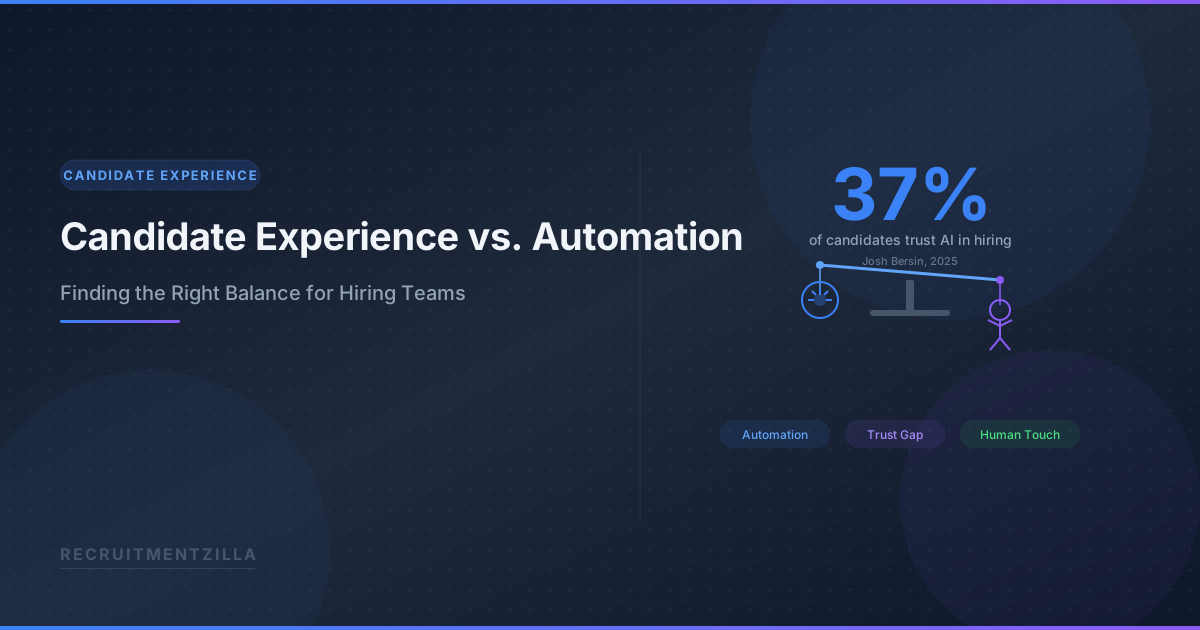
Only 37% of job seekers trust AI to select qualified applicants (Josh Bersin, 2025). Yet 64% of organizations have already deployed AI for recruiting and hiring (Society for Human Resource Management (SHRM), 2025). That gap between what recruiters adopt and what candidates accept is widening, and it’s creating real consequences for offer acceptance, employer brand, and quality of hire.
Companies are racing to automate hiring. Candidates are pushing back. The question isn’t whether to use automation. It’s where, how much, and with what safeguards.
This article provides a data-driven, stage-by-stage framework for deciding what to automate, what to keep human, and how to measure whether the balance is working. Whether you’re building on a complete guide to candidate experience or starting from scratch, you’ll find a practical decision matrix, implementation checklist, and the specific metrics that tell you if your approach is helping or hurting.
Key Takeaways
- 68% of candidates prefer human interaction; 26% would drop out of an AI-only process (ADP, 2026)
- Automate logistics (scheduling, status updates); keep humans for decisions requiring judgment
- 19% of organizations say AI tools screened out qualified applicants (SHRM, 2025)
- Measure candidate sentiment alongside efficiency, not instead of it
- A stage-by-stage decision matrix prevents automation from dehumanizing your hiring process
Why Is There a Trust Gap Between Recruiters and Candidates on AI?
Because candidates can’t see what the algorithm sees. Josh Bersin’s 2025 research found that 79% of job seekers want to know exactly how AI is being used in their hiring process, yet most companies provide zero transparency (Josh Bersin, 2025). This visibility gap, not the technology itself, is what drives distrust.
Recruiters and candidates view AI through entirely different lenses. Talent teams see faster screening, consistent scoring, and reduced administrative burden. Candidates see a black box that might reject them for reasons no one can explain. That perception divide matters more than what’s technically true.
The numbers are stark. Sixty-eight percent of job candidates prefer human interaction during hiring, and 26% say they’d abandon a process that relies entirely on AI (ADP, 2026). Meanwhile, 67% of candidates don’t want AI reviewing their resumes at all (ADP, 2026). These aren’t fringe opinions; they represent the majority of your applicant pool.
Here’s the automation paradox: companies adopt AI specifically to improve candidate experience, then discover they’ve worsened it. The intent is faster responses, shorter timelines, and fewer bottlenecks. The outcome, without transparency, is candidates who feel processed rather than considered.
John Wilson, CEO of WilsonHCG, puts this bluntly: “Companies forget that the candidate experience should be treated like a consumer experience” (SHRM, 2025). Would you stay loyal to a brand that made decisions about you using criteria it refused to share? Most people wouldn’t, and candidates aren’t any different.
What Do Candidates Actually Object To?
The objection isn’t about speed or convenience. Candidates welcome faster responses and streamlined scheduling. What they can’t accept is opaque decision-making and the absence of human accountability when things go wrong.
Craig Fisher of TalentNet Media observes: “The relationship between candidates and recruiters is not as tight because of virtual and automated interactions” (SHRM, 2025). When a candidate gets rejected by an algorithm, there’s no person to ask why, no feedback loop, and no sense that anyone actually read their application. That feeling of invisibility erodes trust far more than the technology itself ever could. The same open communication practices that candidates value internally are what they expect from the hiring process itself.
If your organization uses AI-powered screening tools, understanding how to audit AI bias in your hiring tools is the first step toward closing this trust gap.
Where Do Candidates Actually Drop Off, and What Role Does Automation Play?
Sixty percent of candidates abandon job applications before completing them, and the top reasons, lengthy forms (50%) and missing salary information (31%), are problems automation can either solve or worsen (CareerPlug via RecruitBPM, 2025). The funnel bleeds at every stage, and automation touches each leak point differently.
The hiring funnel is brutally narrow. Only 17% of applicants advance to the interview stage (Josh Bersin, 2025). Of those who do, 61% report being ghosted afterward, up nine percentage points from 2024 (Greenhouse via ADP, 2026). And at the finish line, 52% of job seekers have declined offers due to poor candidate experience (RecruitBPM, 2026).
That last number should alarm every hiring manager. More than half of candidates who make it through your entire process will say no if the experience was poor. You can fill your pipeline with thousands of applicants and still lose your top choice at the offer stage because of how they felt along the way. For teams running high-volume hiring strategies, where funnel math means processing 18,000+ applications per month, these drop-off rates become existential.
Then there’s the screening problem. Nineteen percent of organizations using AI report their tools overlooked or screened out qualified applicants (SHRM, 2025). These aren’t weak candidates slipping through; they’re strong candidates being filtered out. Automation that’s intended to improve screening accuracy is, in roughly one of every five cases, making it worse.
What about the feedback gap? Ninety-four percent of candidates want interview feedback, but only 41% receive it (Talent Board via RecruitBPM, 2026). Automation could close this gap at scale with templated feedback summaries and automated delivery. Instead, most companies deploy automation for screening and scheduling, not for the communication touchpoints candidates actually care about.
Over 80% of candidates who have a negative communication experience during recruitment take at least one negative action in response (Gartner, 2025). They tell friends, leave Glassdoor reviews, decline future referrals, and avoid your brand for years. The cost of poor communication compounds far beyond a single rejected candidate.
If application abandonment is your biggest leak, start with learning how to fix a broken application process.
What Should You Automate, and What Should Stay Human?
The answer depends on whether a task requires judgment or logistics. SHRM’s 2025 research found that 19% of organizations using AI reported their tools overlooked qualified applicants (SHRM, 2025), a clear signal that automating decision-making without guardrails creates real damage.
The framework below breaks the hiring process into five stages and separates tasks into two categories: automate (logistics and repetition) or keep human (judgment and relationship). This isn’t theoretical; it’s built from the data above and from watching what actually breaks when teams automate too aggressively.
Stage 1: Sourcing and Job Distribution
Automate: job posting syndication across boards, Boolean search query generation, initial outreach sequences (a recruitment CRM handles these at scale), and distribution tracking.
Keep human: employer brand messaging, passive candidate relationship-building, and personalized InMail outreach.
The evidence supports this split. AI-assisted messages on LinkedIn have a 44% higher acceptance rate and are accepted 11% faster than non-AI messages (LinkedIn Talent Solutions, 2025). But that uplift only appears when AI handles the template and a recruiter adds genuine personalization. Fully automated outreach with no human touch performs worse than manual messages. The combination matters.
Stage 2: Application and Screening
Automate: resume parsing, form pre-fill, knockout question filtering, and instant application acknowledgment emails.
Keep human: final shortlisting decisions, culture-fit assessment, and reviewing edge-case candidates who don’t match keyword filters but bring relevant transferable skills.
Here’s what makes this stage tricky. Eighty-seven percent of Fortune 500 companies fail to use AI and automation to hyper-personalize career sites for job seekers (Phenom, 2025). Companies deploy automation for efficiency at this stage but ignore the experience side entirely. A career page that feels generic and an application that takes 30 minutes to complete will lose you 60% of applicants before your AI screening tool ever sees their resume.
We’ve seen teams deploy automated rejection emails that arrive 90 seconds after a candidate submits an application. The candidate screenshots it, posts it on social media, and your employer brand takes a hit that no recruiter can repair. The automation worked perfectly. The experience was terrible. Timing and tone matter as much as the decision itself.
Stage 3: Interviewing and Assessment
Automate: scheduling coordination, calendar reminders, interview prep packets, and structured scorecard distribution to interviewers.
Keep human: live conversations, behavioral assessment, candidate Q&A, and rapport-building.
This is the stage where automation risk is highest. Sixty-five percent of candidates say a bad interview experience makes them lose interest in the job (LinkedIn Talent Solutions via Deloitte, 2025). Scheduling is a logistics problem, perfect for automation. But the interview itself is a relationship moment. Replacing live conversation with AI video analysis or chatbot-driven assessments alienates the very candidates you’re trying to attract.
Stage 4: Communication and Feedback
Automate: status updates, timeline notifications, and rejection templates with personalization tokens (candidate name, role applied for, specific stage reached).
Keep human: offer negotiations, detailed interview feedback for finalists, and any conversation that involves sensitive information.
This is where automation has its highest untapped potential. Ninety-four percent of candidates want interview feedback, but only 41% receive it (Talent Board via RecruitBPM, 2026). Automated feedback delivery, even templated summaries with a few personalized notes, could close this gap at scale. Most companies automate the wrong communications. They auto-send rejections but never auto-send feedback. Flip that priority.
Stage 5: Offer and Onboarding Transition
Automate: offer letter generation, document collection, background check initiation, and preboarding task sequences.
Keep human: compensation negotiation, answering candidate concerns about the role or team, and first-week planning.
Remember the statistic: 52% of candidates decline offers due to poor experience (RecruitBPM, 2026). The final handoff from recruiting to onboarding is where many companies lose candidates they’ve already won. Automating the paperwork frees recruiters to spend time on what candidates actually need at this stage: reassurance, connection, and answers to the questions they’re afraid to ask.
For a deeper look at how AI candidate matching platforms handle screening, see our breakdown of the tools available today.
Does Automation Actually Improve or Hurt Hiring Metrics?
It depends on what you measure. SHRM’s 2025 benchmarking survey found that average cost-per-hire and time-to-hire have both increased over the past three years, a period that coincides directly with the sharpest rise in generative AI adoption for recruiting (SHRM, 2025). More automation hasn’t lowered costs or shortened timelines at the aggregate level.
How is that possible? Several forces work against each other. Labor market tightness drives up costs regardless of tools. Tool proliferation without process redesign creates new complexity instead of removing it. And automation applied to the wrong stages, decision-making rather than logistics, generates errors that require human intervention to fix.
The pattern we’ve observed on multiple talent teams is telling: leaders celebrate a 20% improvement in time-to-hire while ignoring that candidate satisfaction scores dropped by 15 points over the same period. The metric that gets reported is the one that looks good. The metric that matters is the one nobody measures.
AI adoption for recruiting grew from roughly 27% in 2023 to 64% in 2025 (SHRM, 2025). Costs went up and timelines grew longer. That correlation doesn’t prove causation, but it does disprove the assumption that AI automatically makes hiring cheaper or faster.
Tiffanie Ross, Senior Director of AIRS at ADP, frames it well: “Technology and humanity are in collaboration, not competition” (ADP, 2026). Companies that pair automation with process redesign see gains. Companies that bolt AI onto broken processes see worse results. The tool doesn’t fix the system; the system has to be fixed first.
The Metrics That Actually Matter
Time-to-hire alone is misleading. Faster isn’t better if quality drops or candidates feel rushed through a process that never gave them a chance to ask questions. What should you track instead?
Application completion rate measures process friction directly. If 60% of candidates abandon your application, no amount of downstream automation will compensate. This is your first diagnostic.
Screening accuracy tracks qualified candidates advanced versus wrongly filtered. With 19% of AI tools screening out good applicants, this metric tells you whether your automation is helping or hurting at the top of the funnel.
Candidate satisfaction scores, whether NPS surveys or post-process feedback, capture what efficiency metrics miss entirely. A fast process that feels dehumanizing still damages your brand.
Offer acceptance rate is the ultimate candidate experience metric. If 52% of candidates decline after poor experiences, your acceptance rate tells you whether the end-to-end journey is working.
How Are Leading Companies Balancing Automation and Human Touch?
The companies getting this right share one trait: they treat AI as a behavioral shift, not just a tooling upgrade. Becky McCullough, VP of Talent Acquisition and Mobility at HubSpot, puts it directly: “Teams pulling ahead treat AI as both a tooling shift and behavioral one” (GoodTime, 2025). The tool changes. But so does how recruiters spend their time.
Three patterns emerge from organizations that balance automation with candidate experience effectively.
Pattern 1: Automate the logistics, humanize the moments. Scheduling, reminders, and status updates run on autopilot. Interviews, feedback conversations, and negotiations always involve a human. This isn’t complicated, but it requires discipline because the temptation to automate “just one more thing” doesn’t let up.
Pattern 2: Transparency-first deployment. These companies tell candidates exactly where AI is used in their process. This directly addresses the 79% who want to know how AI affects their application (Josh Bersin, 2025). A simple disclosure page or a one-line note in the application portal changes the dynamic from “black box” to “informed process.”
Pattern 3: Measuring sentiment, not just speed. Adding NPS surveys and feedback loops at each stage creates a feedback mechanism that efficiency metrics alone can’t provide. When candidate satisfaction drops, these teams catch it before it shows up in declining offer acceptance rates.
Adam Godson, CEO of Paradox, offers the counterpoint: “AI can help candidates have a better experience because of 24/7 availability and fast responses” (SHRM, 2025). He’s right, but availability without empathy is just a faster black box.
Younger candidates actually expect more technology. Forty-seven percent of 18-to-34-year-olds want a TikTok-like personalized career site experience (Phenom/Harris Poll, 2025). The audience isn’t anti-tech; they’re anti-opaque. They want personalized, technology-driven experiences that also feel human and transparent.
The Transparency Playbook
What does transparency look like in practice? Start with these steps.
Add an “About Our Hiring Process” page to your careers site. Describe each stage, note where AI or automation is used, and explain what candidates can expect at every step. This alone addresses the single biggest trust concern candidates report.
Disclose AI use in application portals. A brief statement like “We use automated tools to help organize applications. A recruiter reviews every shortlisted candidate personally” costs nothing and reduces anxiety.
Offer a human alternative at every AI-driven stage. If a chatbot handles initial screening questions, give candidates the option to speak with a person instead. Not everyone will take it, but knowing it’s there changes how people feel about the process.
These steps also align with EEOC compliance requirements for AI in hiring, and they position your organization ahead of emerging EU AI Act mandates that will soon require exactly this kind of disclosure.
What Does a Candidate-First Automation Strategy Look Like in Practice?
It starts with a principle most teams skip: audit the experience before adding tools. Only 26% of North American job seekers say they had a great candidate experience, according to Talent Board’s benchmark research (Talent Board via RecruitBPM, 2026). That means 74% of companies have a baseline problem that technology alone won’t fix.
Here’s the five-step framework.
Step 1: Map your current candidate journey end-to-end. Identify every touchpoint from job listing to first day. Mark each as automated, human, or broken. Most teams discover they have more broken touchpoints than they expected, and fewer human ones than they thought.
Step 2: Apply the decision matrix from the framework above. For each touchpoint, decide: automate, humanize, or redesign entirely. Some processes are so broken that neither automation nor a human can save them. Those need to be rebuilt from scratch.
Step 3: Build in transparency checkpoints. At each automated stage, add a disclosure message and an option to reach a human. We’ve found that the simplest change that improves candidate experience overnight is adding a human name and a direct reply email address to every automated message. It costs nothing. Candidates notice immediately. The perception shifts from “I’m in a system” to “someone is managing my process.”
Step 4: Measure at every stage. Track application completion, screening accuracy, interview satisfaction, and offer acceptance rate. Without measurement, you’re guessing whether your balance is right. Agencies using recruitment technology intentionally report up to 60% savings in hiring costs and 70% faster time-to-fill (Recruiterflow, 2026), but only with deliberate process design behind the tools.
Step 5: Iterate quarterly. Run candidate feedback surveys, compare against benchmark data, and adjust. The right balance today won’t be the right balance six months from now. Tools change. Candidate expectations shift. Regulations evolve.
A candidate-first automation strategy follows five steps: map the current journey, apply a human-or-automate decision matrix at each touchpoint, build in transparency checkpoints, measure at every stage, and iterate quarterly based on candidate feedback data.
The 30-Day Quick-Start Checklist
If a full overhaul feels overwhelming, start here. Four weeks, four priorities.
Week 1: Audit your current process. Map every candidate touchpoint. Identify which are automated, which are human, and which are broken or missing entirely. Talk to five recent candidates and ask what surprised them, positively or negatively.
Week 2: Implement transparency and feedback. Add disclosure statements to your application portal. Launch a one-question post-interview survey. These take hours, not weeks.
Week 3: Deploy automation for your top three logistics bottlenecks. Most teams find the same culprits: interview scheduling, application acknowledgment, and status update communication. Automate these three first.
Week 4: Establish baseline metrics and a review cycle. Record your current application completion rate, time-to-hire, candidate satisfaction score, and offer acceptance rate. Set a quarterly review meeting to compare.
For more depth on the full candidate journey, read our complete guide to candidate experience.
How Will AI Regulation Change the Automation Equation?
It already is. The EU AI Act classifies hiring AI as “high risk,” requiring transparency, human oversight, and mandatory bias audits. In the U.S., EEOC guidance has made clear that employers are liable for bias in automated hiring tools, regardless of whether a vendor built the algorithm. Regulation is catching up to adoption, and fast.
The regulatory landscape is fragmenting. NYC Local Law 144 requires bias audits for automated employment decision tools. The Illinois AI Video Interview Act mandates disclosure and candidate consent before AI analyzes recorded interviews. Multiple states are considering similar legislation. The direction is clear even if the pace varies.
For hiring teams, the practical impact is straightforward. The transparency and human oversight practices described throughout this article aren’t just candidate experience improvements. They’re compliance preparations. Companies that build these safeguards now will be ahead of the curve when regulations tighten further.
Consider the screening risk. Nineteen percent of organizations already acknowledge their AI tools screen out qualified candidates (SHRM, 2025). Under emerging regulations, that’s not just a candidate experience problem. It’s a legal liability. If your tool screens out candidates from protected classes at disproportionate rates, and you can’t demonstrate oversight or audit procedures, the regulatory consequences are significant.
The parallel to salary history bans is instructive. When technology enabled pay discrimination at scale, regulation followed. The same pattern is unfolding with AI hiring tools. If you want to understand how salary history ban compliance works, the lesson applies: proactive companies build fair processes before they’re required to, and reactive companies spend more on compliance than prevention would have cost.
The EU AI Act classifies hiring AI as high-risk, requiring transparency and bias audits. In the U.S., EEOC guidance holds employers liable for bias in automated tools. Companies building human oversight now will be ahead of the compliance curve.
Frequently Asked Questions
Does automation improve or hurt candidate experience?
It depends on where you apply it. Automating logistics like scheduling and status updates improves speed and consistency. Automating decisions like screening and selection without transparency damages trust. Sixty percent of candidates abandon applications due to slow processes (CareerPlug via RecruitBPM, 2025), but 68% prefer human interaction for substantive hiring moments (ADP, 2026).
What percentage of candidates trust AI in hiring?
Only 37% of job seekers trust AI to select qualified applicants, according to Josh Bersin’s 2025 research (Josh Bersin, 2025). Meanwhile, 79% want to know exactly how AI is used, and 26% would drop out entirely from an AI-only process (ADP, 2026).
What parts of the hiring process should not be automated?
Final shortlisting decisions, live interviews, offer negotiations, and any communication requiring empathy or nuance. SHRM found 19% of organizations using AI reported their tools overlooked qualified applicants (SHRM, 2025), underscoring the risk of automating judgment calls. Keep humans where the stakes, and the ambiguity, are highest.
How do you measure whether your automation is helping candidates?
Track four metrics at minimum: application completion rate, screening accuracy (qualified candidates advanced vs. wrongly filtered), candidate satisfaction scores (NPS or survey), and offer acceptance rate. Only 26% of candidates report a great experience (Talent Board via RecruitBPM, 2026), so baseline measurement is essential before you can tell if changes are working.
What AI regulations affect hiring automation?
The EU AI Act classifies hiring tools as high-risk, requiring transparency and bias audits. NYC Local Law 144 requires bias audits for automated employment decision tools. The Illinois AI Video Interview Act mandates disclosure and consent. EEOC guidance holds employers liable for bias in automated screening regardless of vendor responsibility. The regulatory environment is tightening across jurisdictions.
Balancing Candidate Experience and Automation: What the Data Shows
The data tells a clear story. Automation works when it removes friction from logistics, and it backfires when it replaces human judgment without transparency. The 37% trust figure and the 60% abandonment rate mark the two poles of this problem: candidates want faster, simpler processes, but they don’t want to be evaluated by systems they can’t see or question.
The practical takeaway is the decision matrix. Automate logistics. Humanize decisions. Disclose everything. Measure both speed and sentiment. No single tool or policy creates the right balance. It’s the system design, the transparency practices, and the willingness to measure what candidates actually experience that make the difference.
Start with the 30-day quick-start checklist. Map your current process, identify your three biggest logistics bottlenecks, and deploy automation there first. Then measure what happens to your candidate satisfaction scores. If they go up alongside your efficiency metrics, you’ve found the balance. If they don’t, you know exactly where to look.