EEOC compliance in hiring has never carried higher stakes. The agency processed 91,503 new discrimination charges in FY 2025, up 3.4% from the prior year, and recovered $660 million for 17,680 victims (EEOC FY 2025 Press Release, 2026). That pre-litigation recovery was the highest in the commission’s 60-year history. Enforcement is intensifying even as federal priorities shift in new directions.
Most employers know discrimination is illegal. Yet charge volumes keep climbing, which means gaps in day-to-day recruitment workflows persist. Where exactly do teams slip up?
This guide maps every EEOC obligation that touches hiring: protected classes, job postings, screening criteria, AI liability, EEO-1 reporting, and charge response. You’ll find FY 2024 and FY 2025 enforcement data that no other hiring guide puts in one place, alongside a step-by-step checklist your team can run this quarter.
Key Takeaways
- The EEOC filed 91,503 charges in FY 2025 and recovered $660M for victims (EEOC, 2026).
- Retaliation leads all charge types at 47.8%, followed by harassment (40.4%) and disability (38.0%).
- AI hiring liability persists under Title VII even after federal guidance was removed in January 2025.
- A documented, stage-by-stage hiring process is the single best defense against an EEOC charge.
What Does EEOC Compliance Mean for Employers?
EEOC compliance means structuring every hiring decision so no applicant faces disadvantage because of a protected characteristic. In FY 2024, the agency received 88,531 discrimination charges, a 9.2% increase from FY 2023 (EEOC 2024 Annual Performance Report, 2025). The core principle is simple: base employment decisions on qualifications, not protected status.
The Equal Employment Opportunity Commission enforces federal anti-discrimination laws for private employers with 15 or more employees (20 or more for age discrimination under the ADEA). The commission’s jurisdiction covers every stage of the employment relationship, from the language in a job ad to the terms of an offer letter. If your organization touches recruitment, these rules apply to you.
Don’t confuse the EEOC with the OFCCP. The EEOC investigates individual and systemic discrimination charges filed by employees or applicants. The Office of Federal Contract Compliance Programs (OFCCP) conducts proactive audits of federal contractors. Both matter, but their triggers differ. The EEOC responds to complaints. The OFCCP shows up on a schedule.
EEOC compliance covers job advertisements, sourcing channels, screening tools, interview questions, selection criteria, compensation offers, and onboarding terms. Every step in that chain is an enforcement touchpoint. Employers who treat compliance as a “legal review at the offer stage” miss the upstream risks that generate the most charges.
If you’re also dealing with salary history bans that overlap with EEOC compliance, the intersection is compensation discrimination, and it’s worth understanding both obligations in parallel.
Which Laws Does the EEOC Enforce?
The EEOC enforces seven core federal statutes, each protecting different characteristics:
- Title VII of the Civil Rights Act covers race, color, religion, sex (including sexual orientation and gender identity), and national origin.
- Americans with Disabilities Act (ADA) prohibits disability discrimination and requires reasonable accommodations.
- Age Discrimination in Employment Act (ADEA) protects workers aged 40 and older.
- Genetic Information Nondiscrimination Act (GINA) bars the use of genetic information in employment decisions.
- Equal Pay Act (EPA) requires equal pay for equal work regardless of sex.
- Pregnant Workers Fairness Act (PWFA) mandates reasonable accommodations for pregnancy, childbirth, and related conditions.
The PWFA, enacted in 2023, has already transformed the charge landscape. PWFA charges surged nearly 15-fold: from 188 in FY 2023 to 2,729 in FY 2024 (Gen Re EEOC Trends Report, 2025). That spike signals that employees are learning about the new law faster than many employers are updating their policies.
Citation capsule: EEOC compliance requires employers to ensure that every hiring decision, from job postings to final selection, is based on qualifications rather than protected characteristics such as race, sex, age, disability, or genetic information. In FY 2024, the EEOC received 88,531 discrimination charges, a 9.2% increase from the prior year (EEOC 2024 Annual Performance Report, 2025).
What Are the Most Common EEOC Violations in Hiring?
Retaliation topped all FY 2024 charge categories at 42,301 filings, representing 47.8% of all charges (National Law Review, 2025). But the hiring-specific violations that catch employers off guard are disability accommodation failures and discriminatory screening criteria, not retaliation itself.
Here’s what the FY 2024 breakdown looks like after retaliation: harassment at 40.4%, disability at 38.0%, race at 34.2%, and sex at 30.4%. Percentages exceed 100% because a single charge can allege multiple bases. That overlap matters. A disability-related hiring charge often arrives packaged with a retaliation claim once the applicant suspects the employer pulled back after an accommodation request.
What specific hiring practices generate these charges? Discriminatory job requirements rank high. Think unnecessary degree mandates, height or weight thresholds, or physical demands that aren’t tied to essential job functions. Denial of reasonable accommodation accounted for 33.6% of issues in new EEOC lawsuits during FY 2024 (Filippatos PLLC, 2025). Pre-employment medical inquiries asked before a conditional offer create another frequent violation point.
Word-of-mouth recruiting also produces risk. When referral-heavy pipelines generate homogeneous candidate pools, the result can look like systemic exclusion, whether intentional or not.
Are your background check practices staying within EEOC guidelines? Criminal history screening is another area where hiring teams commonly cross the line without realizing it.
What Does EEOC Non-Compliance Cost?
The financial exposure is not theoretical. The EEOC secured nearly $698 million for approximately 21,000 victims in FY 2024 (EEOC FY 2024 Annual Performance Report, 2025). In FY 2025, that figure was $660 million for 17,680 victims.
Systemic discrimination recoveries tell an even sharper story. In FY 2024, systemic cases recovered $23.9 million, a 104% increase from FY 2023. In FY 2025, that number surged another 115% to $55 million (EEOC Annual Performance Reports, 2026). The agency is getting better at building class-wide cases.
The average cost to defend a single employment discrimination lawsuit runs approximately $75,000, while EEOC-sponsored mediation outcomes average roughly $32,000 (Novian Law, 2025). And the EEOC won 97% of its district court cases in FY 2024 (EEOC 2024 Annual Performance Report, 2025). Those odds should make any employer’s cost-benefit analysis clear: preventing violations is cheaper than defending them.
Citation capsule: Retaliation was the most frequently filed EEOC charge type in FY 2024 at 42,301 filings (47.8% of all charges), followed by harassment at 40.4% and disability at 38.0%. The agency achieved a 97% success rate in district court litigation, secured $698 million for victims in FY 2024, and recovered $660 million in FY 2025.
How Do You Build an EEOC-Compliant Hiring Process?
In a 2025 Littler survey, 53% of employers expect the EEOC to prioritize hiring practices enforcement in the coming year (Littler 2025 Annual Employer Survey, 2025). Yet most organizations lack a documented process that maps compliance to each hiring stage. The fix is structural, not aspirational.
Building compliance into hiring means treating each stage as its own checkpoint. We’ve found that the organizations with the fewest EEOC issues don’t rely on training alone. They build guardrails into the workflow so compliance happens by default, not by individual memory.
Job Descriptions and Postings
Every requirement in a job description should tie back to a bona fide occupational qualification (BFOQ). Remove gendered language, unnecessary degree requirements, and physical demands that aren’t essential to the role. Include an EEO statement and accommodation notice in every posting. Display the “Know Your Rights” poster in conspicuous locations, both physical and digital.
Start with compliant job description templates if your current postings haven’t been reviewed in the past 12 months.
Sourcing and Outreach
Diversify recruiting channels beyond employee referrals. A referral-only pipeline produces a candidate pool that mirrors your existing workforce, and if that workforce isn’t diverse, you’ve got a pattern that invites scrutiny. Document your sourcing methods for each requisition. Record which channels you used and why.
Watch your language carefully. The EEOC’s “Project Firewall” initiative, launched in November 2025, specifically targets discriminatory language in job postings, including phrases like “H-1B preferred” or other national-origin-coded terms.
Screening and Selection
Apply identical screening criteria to every applicant for the same position. This sounds obvious, but in our experience, it’s the most commonly violated principle. Hiring managers add “nice to have” filters mid-process, or they weight criteria differently for different candidates without documenting why.
Delay disability-related and medical questions until after a conditional offer. Validate any pre-employment tests for job-relatedness and adverse impact. Use structured interviews with standardized scorecards, and if you don’t have one yet, start with a structured interview scorecard that reduces bias.
In our experience, the single biggest compliance failure point isn’t a deliberate violation. It’s a hiring manager asking “just one more question” during an unstructured conversation that veers into prohibited territory. You might hear “So, do you have kids?” framed as small talk. Or “Where are you originally from?” as an icebreaker. These moments generate charges. Structured interviews prevent them.
Offers and Onboarding
Base compensation on the role, market data, and candidate qualifications, not salary history. Document the business rationale for every selection decision. If someone asks you six months later why Candidate A was hired over Candidate B, you need a defensible answer on paper.
Retain all application materials and hiring records for at least one year. Federal contractors must keep records for two years. In practice, we’ve found that three years of retention is the safer standard, given that some state deadlines extend beyond the federal minimum.
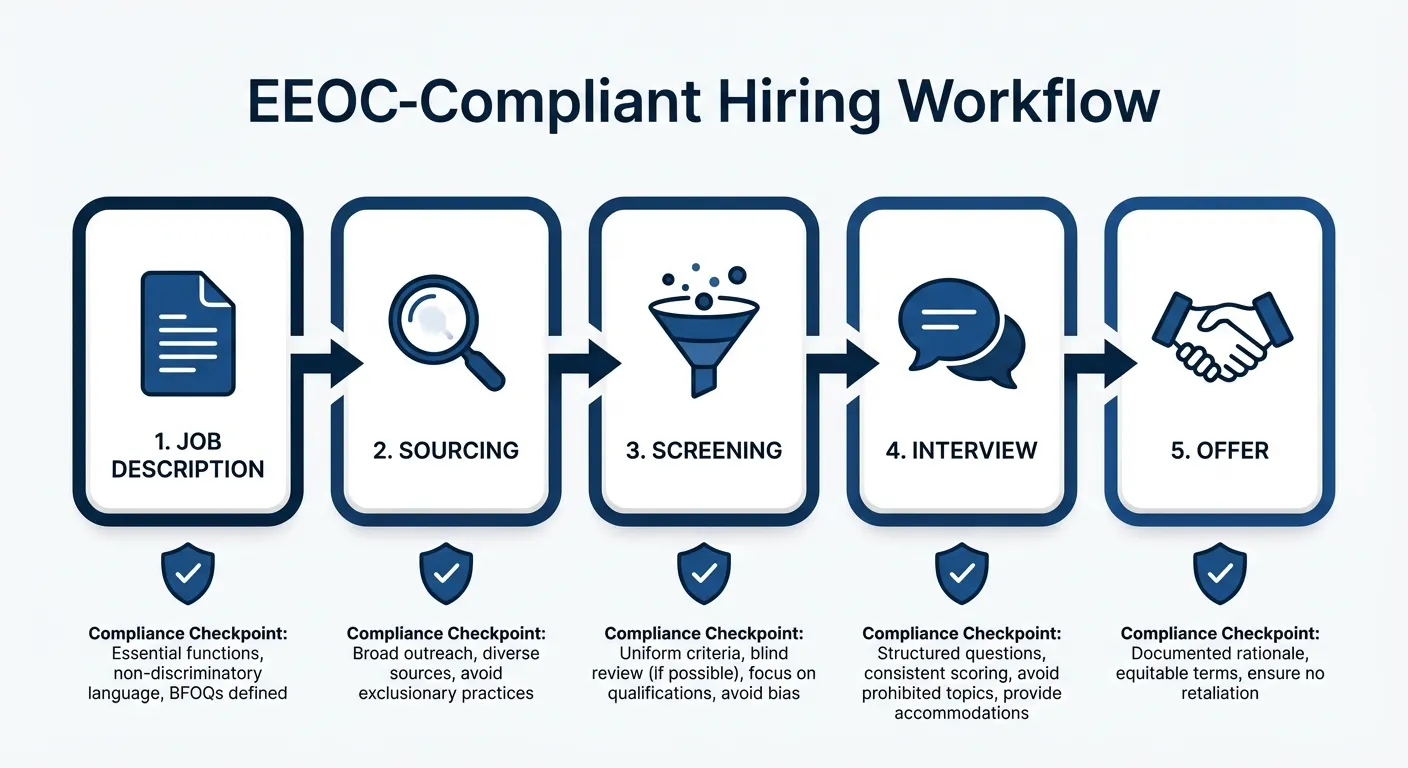
Citation capsule: An EEOC-compliant hiring process applies identical screening criteria to every applicant, ties every job requirement to a bona fide occupational qualification, delays medical inquiries until after a conditional offer, and documents the business rationale for each selection decision. In a 2025 Littler survey, 53% of employers expected the EEOC to prioritize hiring practices enforcement (Littler, 2025).
How Does AI Hiring Technology Create EEOC Liability?
The EEOC removed its AI hiring guidance from eeoc.gov in January 2025, but employers aren’t off the hook. A 2025 Littler survey found that 31% of employers admit to using AI without formal policies (Littler 2025 Annual Employer Survey, 2025). State-level AI hiring laws in Illinois, Colorado, and California now fill the federal vacuum.
The removal of federal guidance doesn’t change the underlying legal framework. Title VII liability for discriminatory hiring outcomes applies whether a human or an algorithm makes the decision. The EEOC deprioritized disparate impact theory at the federal level, closing pending disparate-impact-only charges by October 31, 2025. But private litigation and state enforcement agencies still pursue these claims actively.
Here’s something that should concern every talent team using AI screening tools: SHRM reported that the EEOC “may be seeking a landmark AI discrimination case” through systematic investigations (SHRM Executive Network, 2024). And the Mobley v. Workday lawsuit is testing whether AI vendors face direct liability as employer “agents,” which could reshape the vendor-employer relationship entirely.
What should you do right now? Audit your AI tools for adverse impact. Maintain human override on every automated screening decision. Document vendor validation studies. Notify candidates of AI use wherever state law requires it. For a deeper walkthrough, see our guide on how to audit AI recruitment tools for bias.
Before purchasing any AI screening or matching tool, we’ve found that you need to ask the vendor one specific question: “Can you provide adverse impact validation data for this tool?” Most vendors will not volunteer this information. You have to request it directly, and you should make the request in writing. If a vendor can’t or won’t provide validation data, treat that as a red flag, not a gap you can fill later. Your organization bears the liability for the tool’s outcomes regardless of what the vendor disclosed. Our broader AI in recruitment guide covers the full evaluation framework.
Which State AI Hiring Laws Apply in 2026?
Three states are setting the pace for AI hiring regulation:
- Illinois (effective January 1, 2026): Employers must notify candidates when AI is used in hiring decisions. The law prohibits AI tools that produce biased outcomes against protected classes.
- Colorado (SB 205): Requires annual impact assessments for high-risk AI systems used in employment decisions.
- California: Mandates meaningful human oversight, proactive bias testing, and four-year record retention for automated decision systems used in hiring.
New Jersey and Texas have also adopted AI regulation frameworks that affect hiring, and more states are expected to follow in 2026 and 2027.
Citation capsule: Although the EEOC removed federal AI hiring guidance in January 2025, employers remain liable under Title VII for discriminatory outcomes produced by AI screening tools. Illinois, Colorado, and California have enacted state-level AI hiring laws requiring bias audits, candidate notification, and human oversight. SHRM reports the EEOC may still be pursuing a landmark AI discrimination case (SHRM Executive Network, 2024).
What Changed in EEOC Enforcement for 2025-2026?
Concern about litigation related to DEI practices nearly doubled: 45% of employers now report it, up from 24% the prior year (Littler 2025 Annual Employer Survey, 2025). That jump reflects the most significant enforcement priority shift in a decade, and hiring teams need to understand what moved.
Disparate impact deprioritized at the federal level. The EEOC closed pending disparate-impact-only charges (claims of unintentional discrimination caused by facially neutral policies) by October 31, 2025. This doesn’t mean disparate impact theory is dead. It remains illegal under Title VII, enforceable through private litigation, and actively pursued by state agencies. The federal enforcement posture changed, not the law.
DEI scrutiny intensified. On March 19, 2025, the EEOC and DOJ issued joint guidance warning that certain DEI programs may violate Title VII. The first subpoena in a DEI investigation was issued November 20, 2025. Talent teams running diversity-focused hiring initiatives should review program structures with counsel.
“America First” hiring enforcement launched. Project Firewall, a DOL-EEOC partnership announced November 24, 2025, targets discriminatory hiring practices against American workers. This includes scrutiny of job postings with language like “H-1B preferred” or other terms that signal national-origin preferences.
PWFA enforcement is accelerating. The agency filed seven PWFA lawsuits in FY 2025, up from five in FY 2024, with settlements ranging from $35,000 to $100,000. Given the 15-fold charge increase, expect more litigation in 2026.
Meanwhile, religious discrimination charges dropped from a 2022 vaccine-mandate spike of 13,824 to 3,640 in FY 2024 (Gen Re, 2025). But with a restored Republican-led EEOC majority entering 2026, religious accommodation enforcement is likely to resurface as a priority.
How do 2026 pay transparency laws fit into this shifting landscape? The compliance obligations overlap more than most teams realize, especially around compensation-related discrimination claims.
EEO-1 reporting changes. The non-binary gender option was removed from the form, and client-site reporting has been proposed for 2025 data collection. Filing details for the 2026 cycle are still pending.
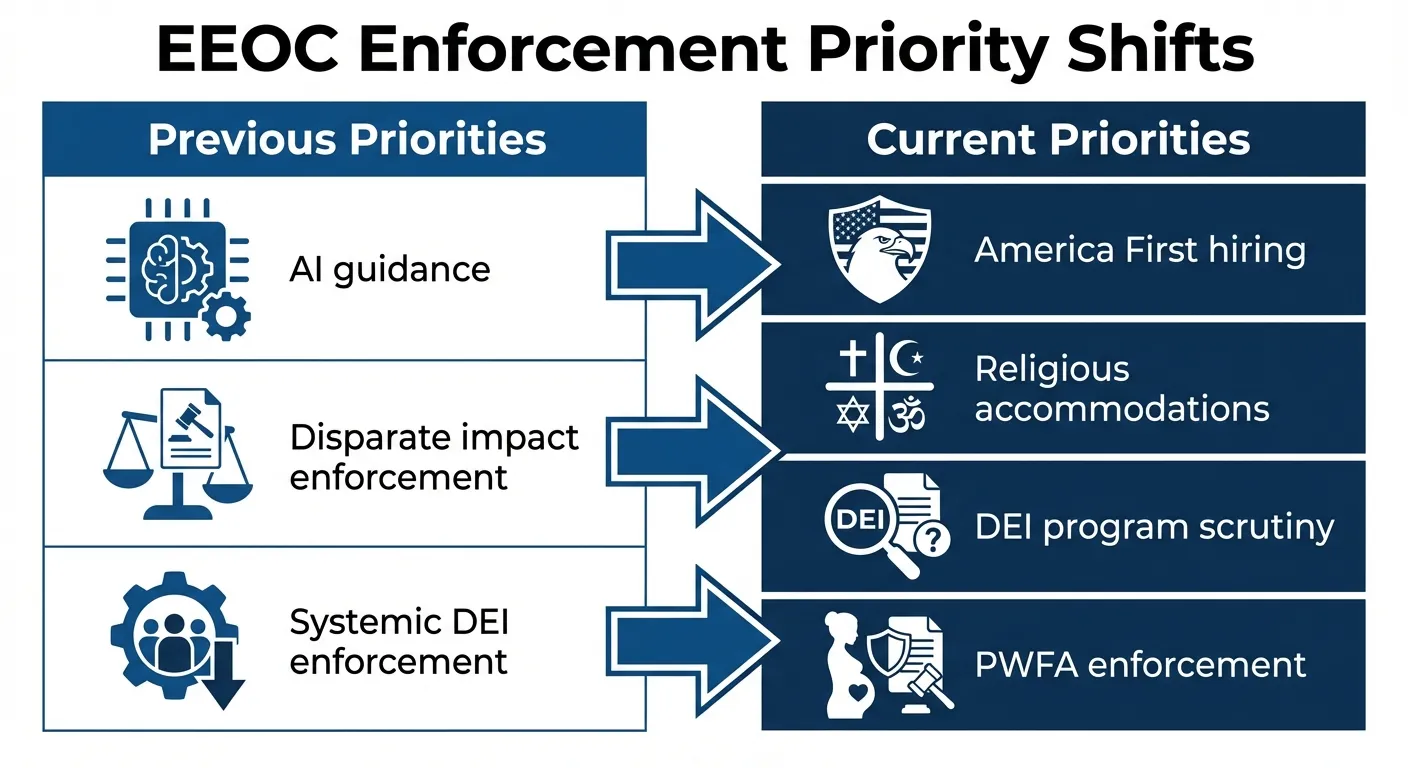
Citation capsule: The EEOC’s enforcement priorities shifted substantially in 2025-2026: disparate-impact-only charges were closed by October 2025, DEI programs face new scrutiny under a March 2025 joint EEOC/DOJ guidance, and Project Firewall targets national-origin discrimination in hiring. Meanwhile, PWFA charges surged nearly 15-fold, from 188 in FY 2023 to 2,729 in FY 2024 (Gen Re, 2025).
How Should You Handle an EEOC Charge?
EEOC mediation resolved 8,543 private sector cases in FY 2024, with a resolution rate above 71% and $243.2 million in total benefits, a 20.8% increase from FY 2023 (EEOC 2024 Annual Performance Report, 2025). Early mediation is the most cost-effective response strategy, and it’s not close.
When a charge is filed, the EEOC notifies the employer within 10 days through the Respondent Portal. From that moment, the clock is running and your response matters. Here’s the step-by-step approach:
Step 1: Preserve all relevant documents immediately. Issue a litigation hold covering emails, interview notes, scorecards, applicant tracking records, and any communications related to the charging party. Destruction of evidence, even accidental, creates severe credibility problems.
Step 2: Review the charge and identify the specific allegations. What protected class is at issue? What adverse action is alleged? What hiring stage is involved? These details shape your response strategy.
Step 3: Consider EEOC mediation. It’s free, confidential, and resolves cases at a 71%+ rate. The average mediation outcome is roughly $32,000, compared to approximately $75,000 to defend a lawsuit (Novian Law, 2025). The math strongly favors mediation for straightforward charges.
Step 4: Submit a thorough position statement. Include factual and legal defenses, supporting documentation, and a clear narrative of your hiring process. This is your opportunity to frame the record before the investigation proceeds.
Step 5: Cooperate with the investigation. Respond to document requests, make witnesses available for interviews, and facilitate on-site inspections if requested. Cooperation doesn’t mean concession. It means professionalism.
Step 6: Protect the charging employee from retaliation. Retaliation charges account for 47.8% of all EEOC filings. We’ve seen employers panic when a charge arrives and immediately change the employee’s status, restrict their duties, or begin a hastily documented performance improvement plan. These reactive moves create retaliation exposure faster than almost anything else. The 47.8% rate exists precisely because employers react before consulting counsel. Take a breath. Call your attorney first.
When should you engage employment counsel? Before the position statement, especially if the charge involves systemic allegations, class-wide claims, or multiple protected classes. The $75,000 average defense cost becomes much higher when early missteps compound.
Citation capsule: When an EEOC charge is filed, employers should immediately preserve documents, review allegations, and consider mediation, which resolved 8,543 cases in FY 2024 at a 71% success rate, yielding $243.2 million in benefits. The average cost to defend an employment discrimination lawsuit is approximately $75,000, compared to roughly $32,000 for a mediated resolution (Novian Law, 2025).
What Does EEO-1 Reporting Require?
Every private-sector employer with 100 or more employees must file an annual EEO-1 Component 1 report. Federal contractors with 50 or more employees and contracts of $50,000 or more also must file (Jackson Lewis, 2026). The 2026 filing cycle brings proposed changes, including client-site reporting requirements that could affect staffing firms significantly.
The EEO-1 report captures employee counts by job category (10 categories), race/ethnicity (7 categories), and sex. The data snapshot covers employees on payroll during a pay period between October 1 and December 31 of the prior year. For the 2025 filing cycle, the deadline was June 24. The 2026 cycle dates haven’t been announced yet.
Two notable changes are in progress. The non-binary gender option has been removed from the form. Client-site reporting has been proposed for 2025 data collection, which means staffing agencies and employers using contingent workers may need to track and report workforce data by physical work location.
Record retention is straightforward but often overlooked: maintain EEO-1 data and supporting documentation for at least one year. In practice, three years is the safer standard, since state requirements and potential litigation timelines often extend beyond the federal minimum.
If you’re managing I-9 compliance requirements that run parallel to EEO-1 filing, consider building a unified reporting calendar so your HR team doesn’t miss overlapping deadlines. Our new hire paperwork checklist maps every federal deadline from day one through day 90.
State-Level Reporting Beyond EEO-1
Federal EEO-1 reporting is the baseline, but three states layer on additional requirements that affect EEOC compliance planning:
| State | Report Type | Deadline | Key Requirement |
|---|---|---|---|
| Massachusetts | Workforce data report | February 1 annually | Required for all EEO-1 filers |
| California | SB 1162 pay data report | Spring (aligned with EEO-1 categories) | Adds compensation data the federal form doesn’t require |
| Illinois | State workforce report | Varies by employer type | Separate submission timeline from federal filing |
These state reports often share data structures with EEO-1, so you can streamline preparation by running them in parallel. But don’t assume the deadlines match. They rarely do.
Citation capsule: Private employers with 100 or more employees must file EEO-1 Component 1 reports annually, categorizing workers by job category, race/ethnicity, and sex. The 2026 cycle introduces proposed client-site reporting, while Massachusetts, California, and Illinois layer additional state-level workforce data requirements with separate deadlines (Jackson Lewis, 2026).
EEOC Compliance Checklist for Hiring Teams
The EEOC filed at least 10 lawsuits against staffing agencies for hiring discrimination in a single fiscal year (Fisher Phillips, 2022). Non-compliance is not theoretical. It is litigated, and the agency targets employers and agencies alike.
Use this checklist as a quarterly audit tool. Every item maps to a specific EEOC obligation or enforcement pattern.
Pre-Requisition
- Confirm EEO poster displayed in physical and digital locations
- Review job description for discriminatory requirements (unnecessary degrees, physical demands not tied to essential functions)
- Include EEO statement and accommodation notice in all postings
- Verify all requirements map to bona fide occupational qualifications
Sourcing
- Use three or more recruiting channels per requisition to diversify pipeline
- Document sourcing methods and channel selection rationale
- Avoid national-origin-coded language in postings (Project Firewall)
- Review referral-heavy pipelines for homogeneity risk
Screening
- Apply identical criteria to all applicants for the same role
- Validate any pre-employment tests for adverse impact
- Delay medical and disability questions until after conditional offer
- Audit AI screening tools for discriminatory outcomes
- Review ban-the-box laws that affect screening for your jurisdictions
Interview
- Use structured interviews with standardized questions and scorecards
- Train interviewers on prohibited questions covering age, religion, pregnancy, disability, and genetic information
- Provide reasonable accommodations for the interview process when requested
- Document all interview evaluations using consistent criteria
Selection and Offer
- Base compensation on role, market data, and qualifications, not salary history
- Document the business rationale for every hire and rejection
- Retain all records for one year minimum (two years for federal contractors)
- Confirm that all selection criteria are defensible if challenged
Ongoing Compliance
- File EEO-1 report annually if applicable
- Conduct annual adverse impact analysis on hiring data
- Update training for hiring managers at least annually
- Review and update this checklist when enforcement priorities shift
Strong candidate experience practices reinforce compliance by creating consistent, documented touchpoints at every stage. When your process treats every applicant the same way by design, compliance becomes a byproduct of good hiring, not a separate burden.
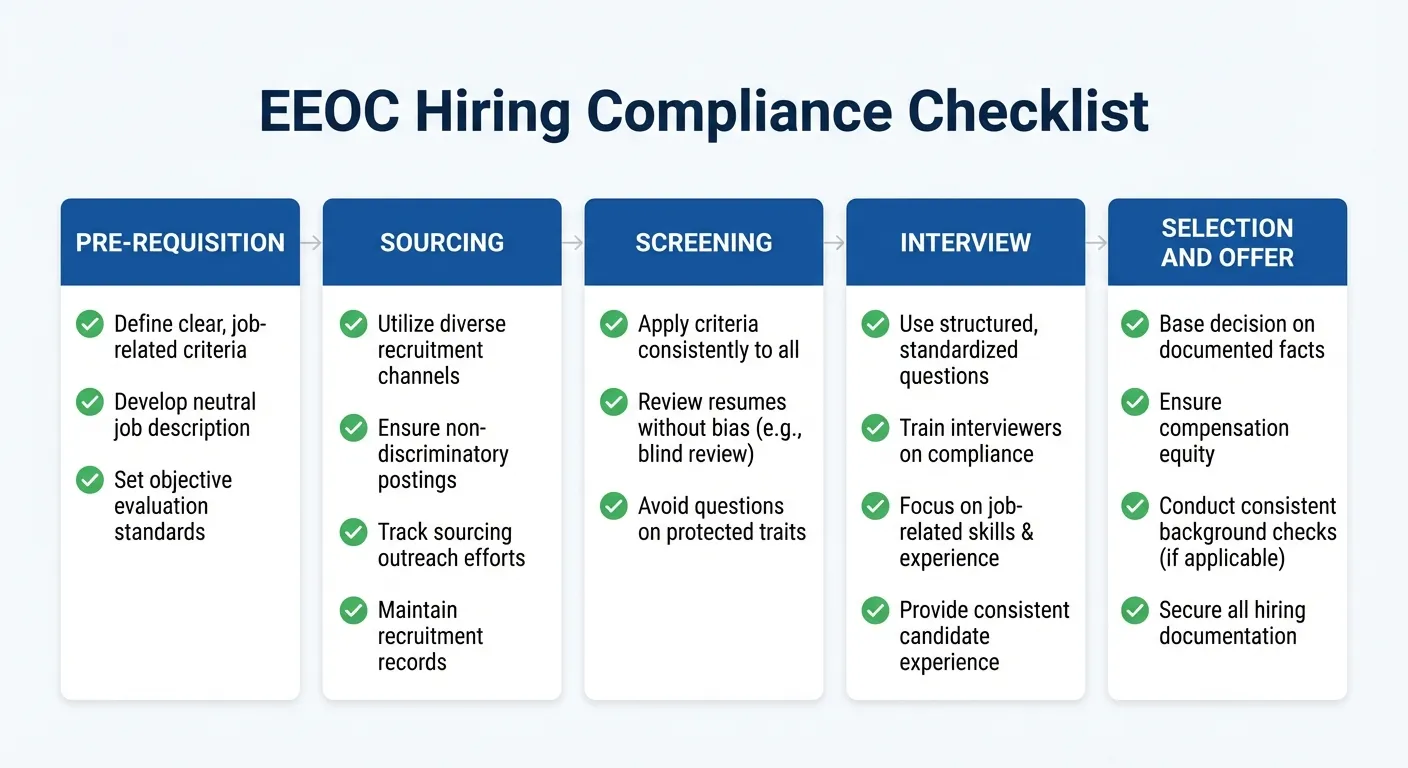
Citation capsule: An EEOC-compliant hiring checklist includes displaying the Know Your Rights poster, using three or more recruiting channels per requisition, applying identical screening criteria to all applicants, using structured interviews with standardized scorecards, delaying medical inquiries until after conditional offers, and retaining all hiring records for at least one year (Fisher Phillips, 2022).
Frequently Asked Questions
What size employer does the EEOC cover?
The EEOC covers private employers with 15 or more employees for most statutes, including Title VII, ADA, GINA, and the PWFA. Age discrimination under the ADEA applies to employers with 20 or more employees. Federal contractors have additional OFCCP obligations starting at 50 employees and $50,000 in contract value.
Can the EEOC investigate a company without an employee complaint?
Yes. The EEOC can initiate directed investigations, also called Commissioner charges, without a formal complaint from an individual. In FY 2024, systemic investigations recovered $23.9 million, a 104% increase from the prior year. In FY 2025, systemic recoveries reached $55 million (EEOC Annual Performance Reports, 2026). Proactive investigations are growing.
How long does an employee have to file an EEOC charge?
Generally 180 calendar days from the date of the discriminatory act. That deadline extends to 300 days if a state or local agency also enforces a parallel anti-discrimination law. Most states have such agencies, so the 300-day window applies in the majority of jurisdictions. Missing the deadline doesn’t erase the claim entirely, but it significantly limits enforcement options.
Do EEOC compliance rules apply to job postings and advertisements?
Yes. Job postings cannot include discriminatory requirements, and the EEOC considers the entire hiring funnel, from ad copy to final selection, within its enforcement scope. Project Firewall, launched in November 2025, specifically targets discriminatory language in job postings, including national-origin-coded phrases.
Are employers liable for AI screening tools that discriminate?
Yes, even if the employer didn’t intend the discriminatory outcome. While the EEOC deprioritized federal disparate impact enforcement, state laws in Illinois, Colorado, and California impose direct AI hiring compliance obligations. Private plaintiffs can still bring disparate impact claims in federal court, and 31% of employers use AI without formal policies (Littler, 2025).
Conclusion
EEOC enforcement isn’t slowing down. The 91,503 charges filed in FY 2025 and $660 million recovered prove that the agency remains active regardless of which administration sets priorities. The underlying laws haven’t changed even as enforcement emphasis has shifted.
EEOC compliance is a process, not a one-time audit. Every talent acquisition decision is a data point that either supports or undermines your defense if a charge arrives. The organizations that build adherence into their recruitment workflow, rather than bolting it on as a legal afterthought, are the ones that avoid the $75,000 average defense cost.
Start with the checklist in the section above. Pick one hiring workflow and audit it this quarter. Review your job descriptions for unnecessary requirements. Confirm your screening criteria are applied identically. Check whether your AI tools have adverse impact validation on file. Small, documented improvements compound over time, and they’re what the commission looks for when deciding whether a charge has merit.