Here’s a stat that should bother you: 77% of organizations run a formal employee referral program, but only 2% report that their program actually meets its hiring goals (WorldatWork, 2024). That’s a 75-point gap between having a program and having one that works.
Most companies treat referral programs as set-and-forget. Post a policy, dangle a bonus, wait. The result is low participation, wasted budget, and a quiet death by neglect.
This guide covers the data behind why referrals outperform every other channel, a step-by-step build process, the bonus-size trap most companies fall into, and how to keep your program delivering year after year.
Key Takeaways
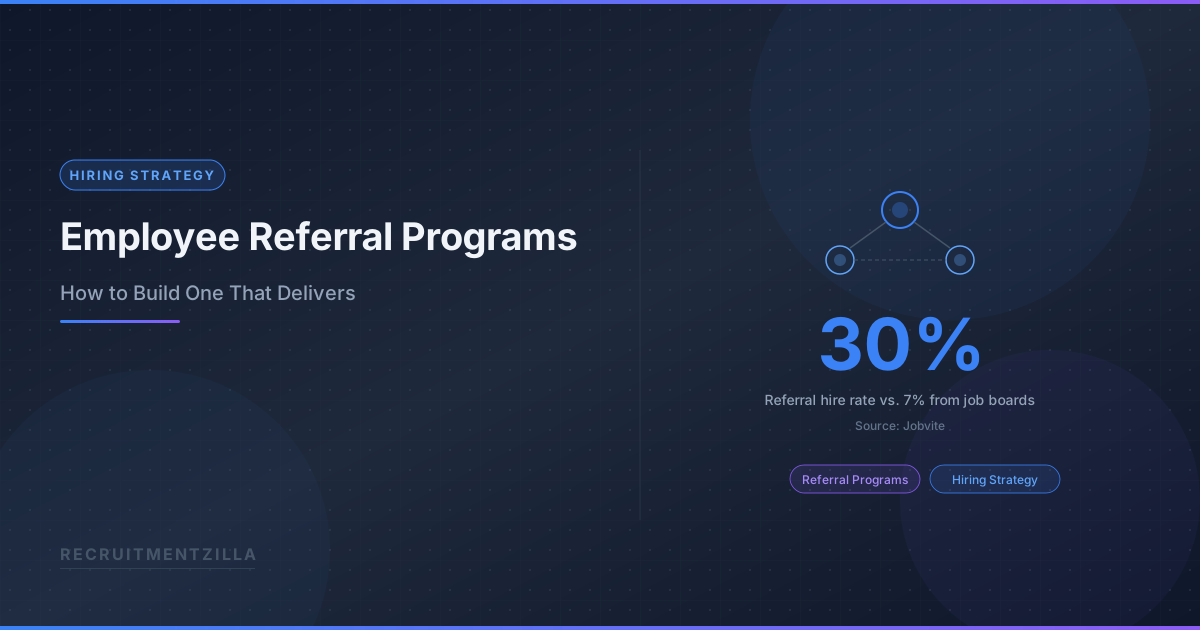
- Referred candidates are hired at 30% vs. 7% from job boards (Jobvite, 2024)
- Average time-to-hire drops from 44 days to 29 days through referrals
- Larger bonuses increase referral volume but decrease quality
- Intentional design turns referral programs into diversity tools
- The 48-hour acknowledgment SLA is the single biggest participation driver
Why Do Employee Referrals Outperform Every Other Hiring Channel?
Referred candidates are hired at a 30% rate compared to just 7% from job board applicants (Jobvite/Aptitude Research, 2024). Referrals represent only 7% of all applicants yet account for 30-50% of all hires (Zippia, 2026). The math is hard to argue with.
Why the massive conversion gap? Referrals come pre-vetted for culture fit. Nine in ten hiring failures stem from culture mismatch, not skills gaps (Recruitee, 2024). When your employees refer someone, they’re putting their reputation on the line. That personal stake acts as a quality filter no algorithm can replicate.
The speed advantage compounds the quality edge. Referral hires take an average of 29 days to close, compared to the 44-day overall average (Zippia/SilkRoad, 2026). That’s 15 fewer days of vacancy costs, lost productivity, and hiring manager frustration.
Then there’s retention. A three-year Deloitte study found referral hires have a 46% retention rate after one year versus 33% for job board hires and just 14% for career site hires (Deloitte/Recruitee, 2023). Over time, 45% of referred hires stay four or more years compared to 25% of job board hires who stay just two (SHRM/SilkRoad, 2017).
What does this mean for your budget? The average cost per hire sits at $4,700 to $5,475 (SHRM, 2023-2025). Referral hires save an estimated $1,000 or more per placement. Multiply that across dozens of hires and you’re looking at real money, not a rounding error. For more context on these numbers, check our guide to cost per hire benchmarks.
The Numbers Behind the Referral Advantage
Walk through the funnel and the picture gets even clearer. Of all referral applicants, 38% advance to the candidate phase compared to 21% of non-referrals. One in ten referrals results in a hire versus just 2% of non-referrals (Hireology, 2024).
Compare that side-by-side with job boards: you need roughly 100 job board applicants to make one hire. You need about 5 referrals (Greenhouse, 2024). That’s a 20x efficiency difference. If you’re serious about measuring quality of hire, referral source tracking should be your starting point.
Citation Capsule: Referred candidates are hired at a 30% rate compared to 7% from job boards, represent just 7% of applicants but account for up to 50% of all hires, and reach the offer stage in 29 days versus the 44-day overall average (Jobvite/Aptitude Research, 2024; Zippia, 2026).
How Do You Build an Employee Referral Program From Scratch?
The 82% of companies that use referral programs in some form (Aptitude Research, 2022) all started with the same foundational steps. But the 2% that hit their goals executed them differently. Here’s what separates a living program from a policy that gathers dust on the intranet.
The difference isn’t about having fancier software or bigger bonuses. It’s about operational discipline. Every successful program we’ve studied shares seven characteristics, and skipping even one of them creates a failure point that compounds over time.
Step-by-Step Breakdown
Step 1: Define which roles are eligible. Don’t launch for every position at once. Start with your three hardest-to-fill roles. This creates urgency and focus. Employees know exactly who you’re looking for.
Step 2: Design the incentive structure. Combine cash with non-cash rewards. Tier your payouts so the biggest reward comes after a retention milestone, not on day one. We’ll cover the bonus-size paradox in the next section.
Step 3: Make submitting a referral dead simple. One click. Mobile-friendly. No cover letters, no lengthy forms. If it takes more than 60 seconds, you’ve already lost most participants. Your applicant tracking system should handle referral intake natively.
Step 4: Set a 48-hour acknowledgment SLA. This is the single most important operational decision you’ll make. When an employee submits a referral and hears nothing for two weeks, they won’t submit another one. Ever. Acknowledge every referral within 48 hours, even if it’s just to say “received and under review.”
Step 5: Keep referring employees in the loop. Update them when their referral moves stages. A simple automated email, “Your referral just completed a phone screen,” costs you nothing and maintains engagement.
Step 6: Track the metrics that matter. Referral-to-hire ratio, time-to-fill delta versus other sources, first-year retention rate, and cost-per-hire difference. If you aren’t measuring, you’re guessing.
Step 7: Review and iterate quarterly. Pull the numbers every quarter. Which departments refer the most? Which roles get zero referrals? Where do referred candidates drop out of the funnel? Adjust your eligible roles, communication tactics, and incentives based on what you find.
Citation Capsule: Building an effective employee referral program requires seven steps: define eligible roles, design tiered incentives, simplify submissions, set a 48-hour response SLA, maintain candidate status transparency, track referral-to-hire metrics, and iterate quarterly. Only 2% of programs meet their goals (WorldatWork, 2024).
What Should You Offer as a Referral Bonus (Without Killing Quality)?
The average referral bonus is $2,500, with 69% of companies paying between $1,000 and $5,000 (Zippia/SHRM, 2026). But here’s where most program designers go wrong: peer-reviewed research reveals that throwing more money at the problem actually makes it worse.
The instinct makes sense. Pay more, get more referrals. But a 13-month randomized controlled trial on 10,000+ workers at a European grocery chain found the opposite (NBER Working Paper 25920, 2023). Larger bonuses did increase referral volume. They also decreased referral quality. Why? Because high bonuses incentivize employees to refer anyone with a pulse rather than carefully selecting strong matches.
The Bonus-Size Paradox Explained
The NBER study revealed something even more interesting than the headline finding. The overall program reduced attrition by 15%, but the benefit came primarily from indirect effects, not just the referral hires themselves. Workers valued being involved in hiring decisions. They felt ownership. That sense of ownership drove retention across the entire workforce, not only among referred employees.
We’ve seen this play out in practice. When one company raised their referral bonus from $1,500 to $5,000, submission volume tripled overnight. Sounds great, right? Except interview-to-hire ratios dropped by half. Hiring managers got buried in weak referrals and started ignoring the pipeline entirely. The program effectively died under its own weight.
The fix was a tiered structure: $500 on submission (rewarding the behavior), $1,500 on hire date, and $1,500 after 90 days of retention. Total payout was $3,500 for a successful long-term hire, but the split structure protected against early turnover and kept quality signals intact.
Non-cash options also work. InMobi offered Royal Enfield bikes in India and Vespas in the US, pushing their referral rate from 20% to 50% for a 900-person company (AIHR, 2024). Accenture lets employees direct their referral bonus to charity with company matching. Google asks “Who is the best developer you know?” to shift the frame from bonus-seeking to personal recommendation.
What’s the right number for your company? It depends on your industry. Tech sector averages $5,000. Healthcare runs about $1,700. Retail sits around $700. The principle stays constant: reward quality over quantity, and split the payout across milestones. For context on how these bonuses fit into total hiring spend, see our cost per hire benchmarks.
Citation Capsule: NBER research across 10,000 workers found that larger referral bonuses increase volume but decrease candidate quality. The average referral bonus is $2,500, but the real program benefit, a 15% reduction in overall attrition, comes from involving employees in hiring decisions (NBER/Journal of Political Economy, 2023).
How Do You Keep Employees Actively Referring?
Companies that enable social media sharing of referral jobs see 3x higher employee participation (Aptitude Research, 2022). Yet most programs fail because of a simpler problem: employees don’t know what jobs are open (WorldatWork, 2024).
WorldatWork and HireClix identified four failure modes that kill referral programs. First, employees are unaware of current openings. Second, the submission process is too complex. Third, referrals receive no status updates after submission. Fourth, successful referrers go completely unacknowledged. Fix all four and you’ve addressed the root causes of low participation.
Here’s what we’ve found kills programs faster than anything else: the big-launch-then-silence pattern. A company announces a referral program with banners, all-hands mentions, and excitement. Then nobody talks about it again. Within 90 days, participation drops to near zero. The program isn’t dead because of bad incentives or poor design. It’s dead because people forgot it exists.
The antidote is relentless, lightweight communication. Weekly open-role emails. A dedicated Slack channel for referral updates. Team meeting shoutouts when a referral gets hired. None of this requires budget. It requires discipline.
Gamification and Communication Tactics That Work
Gamification elements, leaderboards, points, and badge systems, increase participation by up to 70% according to LinkedIn data. Fiverr runs referral leaderboards where top referrers earn recognition and small perks. Quarterly recognition events celebrate the employees whose referrals resulted in hires.
Mobile matters too. A growing majority of millennial and Gen Z workers prefer mobile referral tools. If your submission form only works on desktop, you’re excluding the people most likely to have strong professional networks on platforms like LinkedIn and Instagram.
The smartest tactic? Reward the behavior, not just the outcome. Greenhouse recommends giving small rewards ($25-$50 gift cards) for submitting a referral regardless of outcome, then a larger bonus when the referral actually gets hired (Greenhouse, 2024). This separates the act of referring from the luck of the hiring outcome.
A strong employee value proposition makes all of this easier. When your team genuinely believes your company is a good place to work, they don’t need convincing to refer their friends. Referral programs amplify existing enthusiasm. They can’t manufacture it.
Citation Capsule: The four reasons referral programs fail: employees don’t know what roles are open, the submission process is too complex, referrals receive no status updates, and successful referrers go unacknowledged. Social sharing tools triple participation rates (Aptitude Research, 2022).
Can Referral Programs Improve Diversity (or Do They Hurt It)?
The concern is real: employees tend to refer people who look like them. But Stanford research across 16,000 employees found that Black employees hired through referrals were 1.2x more likely to be promoted than non-referred peers (Sterling & Merluzzi, ILR Review). Referrals aren’t inherently bad for diversity. Unstructured referrals are.
The homophily risk is well-documented. Without intentional design, referral programs can reinforce existing demographic patterns within your workforce. If your engineering team is 85% male, their referral networks will likely skew male too. But several companies have proven that deliberate program design flips referrals from a diversity liability into a diversity advantage.
Intel doubled referral bonuses for underrepresented candidates and increased diverse hires from 32% to 41% (AIHR, 2024). That’s a nine-point improvement from a single policy change. The higher bonus signaled organizational commitment without requiring complex infrastructure.
Three strategies consistently work for building diversity into referral programs:
Engage Employee Resource Groups. ERGs expand referral networks beyond homogeneous circles. When your Women in Engineering ERG actively participates in the referral program, you tap into professional networks your broader team might never reach.
Track demographics alongside hiring data. You can’t fix what you don’t measure. Monitor who’s being referred, who’s advancing through the funnel, and who’s getting hired. If referral demographics don’t match your diversity goals, you’ve identified the gap.
Offer differentiated incentives. Following Intel’s model, increase bonuses for referrals from underrepresented groups. This isn’t about lowering the bar. It’s about expanding the search radius.
Newer research from the LSE (2025) adds another dimension: employees hesitate to refer neurodiverse candidates when they believe the workplace lacks proper accommodations. Fixing the workplace environment unlocks a broader range of referrals.
From an EEOC compliance perspective, word-of-mouth recruiting from homogeneous teams can create Title VII liability. Documenting your diversity-intentional program design isn’t just good practice. It’s legal protection.
Citation Capsule: Stanford research on 16,000 employees found Black hires through referrals were 1.2x more likely to be promoted. Intel doubled referral bonuses for underrepresented groups and increased diverse hires from 32% to 41% (AIHR, 2024). Intentional program design turns referrals into a diversity tool.
How Do You Measure Referral Program ROI?
63% of organizations are not measuring ROI on their sourcing investments (ERE/Aptitude Research, 2022). That means most companies have no idea whether their referral program is working, breaking even, or actively wasting money. You can’t optimize what you don’t measure.
Organizations that do track referral performance are 2x more likely to improve quality of hire (Aptitude Research, 2022). The correlation makes sense: measurement creates accountability, accountability drives iteration, and iteration produces results.
Four metrics tell you everything you need to know:
Referral-to-hire ratio. What percentage of submitted referrals become hires? Benchmark: about 1 in 5 referrals should result in a hire. If you’re below 10%, your employees might not understand what “good” looks like. If you’re above 30%, you might not be getting enough volume.
Time-to-fill delta. Compare days-to-hire for referral candidates against all other sources. The benchmark gap is 15 days (29 vs. 44), but your specific gap tells you how much productivity you’re recovering.
First-year retention rate. Referral hires should retain at 46% or higher at the one-year mark. If they’re retaining at the same rate as job board hires (33%), something is broken in your selection or onboarding process. For more on keeping new hires, see our new hire retention strategies.
Cost-per-hire difference. Factor in bonus payouts, program administration time, and communication costs. Then compare against your average cost per hire of $4,700-$5,475. Most programs show $1,000+ in savings per referral hire even after bonus costs.
The ROI formula itself: take sourcing cost savings plus speed-to-fill productivity gains plus retention value. Subtract bonus payouts and program admin costs. What remains is your program ROI. Track monthly, report quarterly, benchmark annually against quality of hire metrics.
Citation Capsule: Calculate referral program ROI by combining sourcing cost savings, speed-to-fill productivity gains, and retention value, then subtracting bonus payouts and admin costs. Organizations using structured referrals are twice as likely to improve quality of hire (Aptitude Research/ERE, 2022).
What Technology Do You Need to Run a Referral Program?
75% of companies now use automated systems to manage referral workflows (Zippia, 2026), and companies using AI-driven referral platforms report a 40% reduction in time-to-hire. The days of managing referrals through email threads and spreadsheets should be over.
Your referral tracking should live inside your existing ATS, not in a parallel system. Greenhouse and Workable both offer native referral portals within their platforms. Recruiterflow and Hireology provide referral attribution tracking that connects the dots from submission to hire to retention milestone.
For companies needing dedicated referral infrastructure, platforms like ERIN (from $999/month), Boon, Avature Refer, and Teamable offer purpose-built features: one-click submission, automated status notifications, social sharing links, mobile apps, gamification elements, and analytics dashboards.
Key features to prioritize when evaluating tools:
- One-click referral submission from mobile or desktop
- Automated acknowledgment within your 48-hour SLA
- Status update notifications to the referring employee
- Social sharing links for LinkedIn, email, and messaging apps
- Analytics dashboard showing conversion rates by source, department, and referrer
- Integration with your existing ATS and HRIS
The newest development in referral technology is AI-powered matching. Some platforms now suggest which employees are most likely to know strong candidates for specific roles, based on their professional networks, past referral success, and team connections. This turns passive referral programs into proactive ones.
As Madeline Laurano from Aptitude Research puts it: “Technology and automation can help companies create more consistent and meaningful relationships, expand talent pools, and track and measure effectiveness” (Lever/Aptitude Research, 2023). For a broader view of platforms that support referral workflows, check our comparison of recruiting software with referral features.
Citation Capsule: Modern referral platforms integrate with your ATS and offer one-click submission, automated status updates, social sharing, gamification, and analytics. Dedicated tools like ERIN, Boon, and Avature Refer start at $999/month and support mobile-first workflows. 75% of companies now use automated referral systems (Zippia, 2026).
What Do the Best Referral Programs Look Like in Practice?
Salesforce paid $5.5 million in referral bounties and hosts Recruitment Happy Hours where employees invite potential candidates for informal meetups (AIHR, 2024). That investment isn’t charity. It’s their single largest source of quality hires. But you don’t need a $5.5 million budget to steal their playbook.
Salesforce creates low-pressure environments where recruiters meet referred candidates in social settings. No formal interviews. No pressure. Just conversations over drinks. By the time a referred candidate enters the formal process, both sides already know if there’s a fit.
InMobi took experiential rewards to an extreme. For their 900-person company, they offered Royal Enfield bikes in India and Vespas in the US. Result: referral rate jumped from 20% to 50%. The rewards were memorable, shareable, and created buzz that kept the program top of mind.
Google doesn’t rely on bonuses as the primary motivator. They ask employees: “Who is the best developer you know?” The framing shifts from “who do you know who needs a job?” to “who is excellent?” That question reframe produces higher-quality referrals without changing the incentive structure.
PURE Insurance integrated referral asks directly into new-hire onboarding and now sources 40-60% of employees through referrals. The logic is sound: new hires are still excited about the company and actively connected to former colleagues who might be interested.
In our experience, onboarding is the single best moment to ask for referrals. New employees haven’t yet adjusted to treating their workplace as “normal.” They’re still telling friends about their new role. They still have fresh relationships at their previous company. Capturing that window of enthusiasm produces better referrals than any quarterly reminder email.
Lessons From Companies Getting It Right
The common thread across all these examples: successful programs reward behavior (not just outcomes), make submission effortless, and keep employees informed throughout the process. None of these companies treat their referral program as a one-time policy announcement.
For startup hiring strategies, referral programs are especially valuable. With limited recruiting budgets and no employer brand recognition, your employees’ networks become your primary talent pipeline. Start with the PURE Insurance model: integrate referral asks into onboarding from day one.
Citation Capsule: Salesforce pays $5.5 million in annual referral bounties and hosts Recruitment Happy Hours. InMobi increased its referral rate from 20% to 50% with experiential rewards. PURE Insurance sources 40-60% of hires through referrals by integrating asks into onboarding (AIHR, 2024).
Frequently Asked Questions
What is the average employee referral bonus?
The average is $2,500, with 69% of companies offering between $1,000 and $5,000 (Zippia/SHRM, 2026). Industry matters significantly: tech averages $5,000, healthcare $1,700, and retail approximately $700. Tiered payouts split across milestones protect quality while maintaining participation.
How long do referred employees stay?
Referral hires show 46% retention at one year versus 33% for job board hires (Deloitte, 2023). Long-term numbers are even more compelling: 45% of referred hires stay four or more years compared to just 25% of job board hires who stay two years (SHRM, 2017).
Do employee referral programs hurt diversity?
They can if left unstructured, but intentional design turns them into a diversity tool. Intel doubled referral bonuses for underrepresented groups and increased diverse hires from 32% to 41% (AIHR, 2024). ERG involvement, demographic tracking, and differentiated incentives address the homophily risk directly.
How many referrals does it take to make a hire?
On average, you need about 5 referrals to make one hire compared to 100 job board applicants per hire (Greenhouse, 2024). That 20x efficiency advantage makes referrals the highest-converting source in nearly every hiring funnel we’ve analyzed.
Should you pay the referral bonus immediately or in installments?
Best practice is a split payout: half on start date, half after a 90-day retention milestone. Bonuses under $500 are typically paid in one installment. Above $2,000, the two-installment model protects against early turnover and reinforces that your program values retention over volume.
Conclusion
The 75-point gap between having a referral program (77%) and having one that meets its goals (2%) isn’t about bad employees or weak incentives. It’s about execution. Programs fail because nobody talks about them after launch. They fail because submission is too complex. They fail because referring employees hear nothing for weeks.
The fix is operational, not aspirational. Start with your hardest-to-fill role. Implement the seven-step framework for one quarter. Set that 48-hour acknowledgment SLA and stick to it. Track your referral-to-hire ratio, time-to-fill delta, and retention rates. Then iterate.
Referral programs aren’t passive recruiting tools. They’re living systems that require ongoing communication, measurement, and adjustment. But the companies that get them right, the 2%, hire faster, retain longer, and spend less doing it. That’s worth the effort.
For more on turning your entire workforce into a recruiting channel, see our guide on employee advocacy for recruiting.