Sixty-nine percent of organizations reported difficulties recruiting for full-time positions in 2025 (SHRM, 2025). Startups feel this pressure hardest because they compete against employers with bigger budgets, stronger brands, and deeper talent pipelines. A startup founder filling three roles faces over $16,000 in hiring costs before anyone delivers a dollar of value.
Hiring for startups requires a fundamentally different approach than what works at larger companies, and most founders don’t have one. They default to posting on generic job boards, waiting, and hoping the right candidate stumbles in. That approach fails even at well-funded companies. At a startup, it’s fatal.
This guide covers the data-backed strategies startups use to win talent against bigger competitors, from employer branding on zero budget to equity frameworks, referral programs, and skills-based hiring. Every recommendation here is grounded in current research and built for founders who don’t have an HR department yet.
Key Takeaways
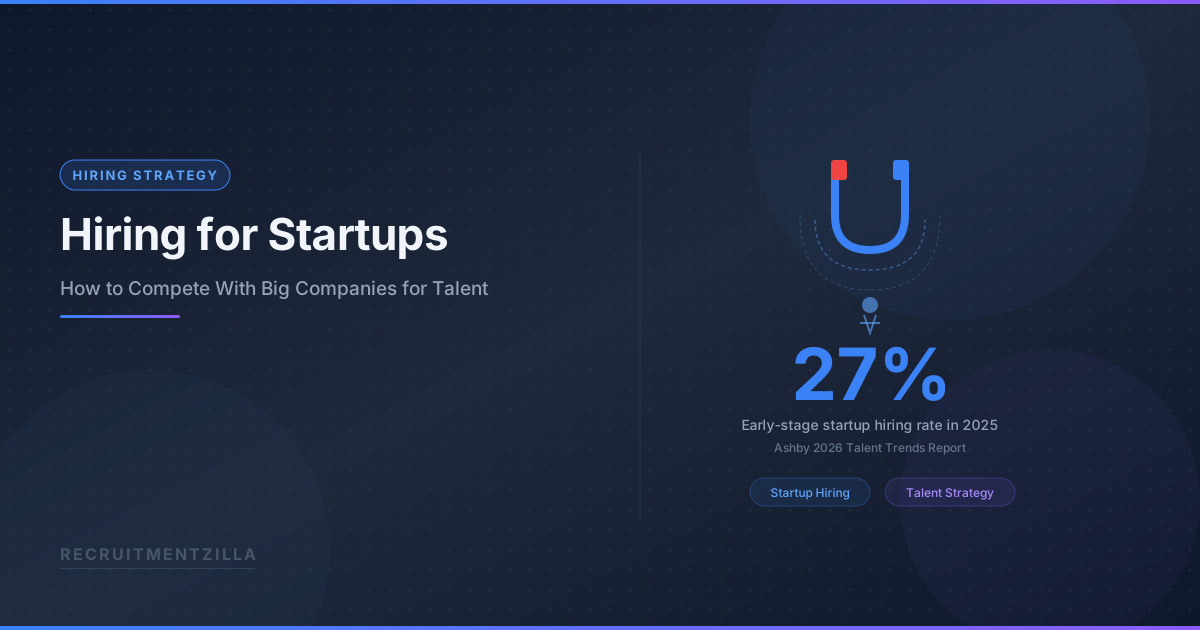
- Early-stage startup hiring rates dropped from 49% to 27% since 2022 (Ashby, 2026)
- Referred candidates convert at 30% versus 2-5% from job boards
- Lead with equity, flexibility, and career growth to outmaneuver larger employers
- Skills-based hiring unlocks talent pools that rigid enterprise processes filter out
Why Is Hiring for Startups So Much Harder Than It Looks?
Hiring rates at early-stage startups dropped from 49% in 2022 to just 27% in 2025, converging with growth-stage companies at 30% (Ashby, 2026). Every single hire now carries disproportionate weight, and the margin for error is razor-thin.
The financial math is punishing. The average cost per hire is $5,475 based on a survey of 2,371 employers (SHRM, 2025). For a seed-stage startup filling three roles, that’s $16,425 before anyone produces output. A bad hire costs at least 30% of first-year earnings according to the U.S. Department of Labor (2025). At a 10-person startup, one wrong hire affects 10% of the entire team’s productivity.
The talent shortage compounds the problem. Seventy-six percent of employers globally struggle to find skilled candidates (ManpowerGroup, 2025). Startups face this shortage plus brand recognition disadvantages, lower base salaries, and no structured HR function. If budget is the primary constraint, start with a $0 hiring stack for startups before investing in paid tools.
So what exactly are startups up against?
What Startups Actually Compete Against
Big companies offer stability, brand prestige, structured career paths, and higher base compensation. These are real advantages that no amount of motivational talk can erase. A candidate choosing between a recognizable Fortune 500 brand and a seed-stage startup with 8 employees is making a risk calculation, not just a career decision.
But large companies also create openings through their own failures. A Greenhouse study found that 72% of candidates report the job they applied for differed from what was offered (Greenhouse, 2025). That gap between promise and reality creates an opportunity for startups willing to be transparent about what the role actually involves, including the hard parts.
Early-stage startup hiring rates dropped from 49% in 2022 to 27% in 2025, according to Ashby’s analysis of 1,200 venture-backed startups. The average cost per hire is $5,475 (SHRM, 2025), making every hiring decision at a startup financially significant.
What Do Candidates Actually Want Beyond a Big Salary?
A LinkedIn survey of 37,000 members found that 48.5% prioritize work-life balance and 43.9% want flexible work arrangements (LinkedIn Global Talent Trends, 2024). These are areas where startups structurally outperform large employers without spending a dollar more.
Compensation remains the top priority at 62.3%. No surprise there. But the gap between the first and second priorities is narrower than most founders assume. Candidates rank work-life balance just 14 points behind pay. That’s a gap a startup can close with the right positioning.
Before candidates even evaluate your compensation, 86% of them research company reviews and ratings (Glassdoor, 2025). They’re reading about your culture, leadership, and daily work experience. A startup with five genuine Glassdoor reviews describing real impact and autonomy will outperform a large company with hundreds of reviews averaging 3.2 stars.
Career growth velocity is where startups hold a structural advantage most founders undersell. At a startup, a junior hire can become a department lead in 18 months. At an enterprise, that same trajectory takes five to seven years. Why don’t more founders put this front and center in their job postings?
The Startup Advantage Framework
Startups compete on different axes than big companies. Here’s how the matchup looks across the five things candidates value most:
- Speed of career growth vs. structured career ladder
- Equity upside vs. higher base salary
- Mission alignment vs. brand prestige
- Autonomy and flexibility vs. stability and benefits
Startups win on three of the top five candidate priorities. But only if they articulate these advantages explicitly in job postings, career pages, and interviews. Most startups assume candidates already understand the tradeoff. They don’t. You need to spell it out. Start by defining your employee value proposition, which is the foundation for every hiring conversation.
A LinkedIn survey of 37,000 professionals found 48.5% prioritize work-life balance and 43.9% want flexible work, ranking only behind compensation at 62.3%. Startups that lead job postings with these advantages attract candidates who self-select for culture fit over brand prestige.
How Do You Build an Employer Brand With No Marketing Budget?
Eighty-six percent of job seekers research reviews before applying (Glassdoor, 2025). Your employer brand already exists in Glassdoor reviews, LinkedIn posts, and candidate word-of-mouth. The question isn’t whether you have a brand. It’s whether you’re shaping it or letting it shape itself.
Glassdoor is the starting point. Seventy percent of users are more likely to apply when an employer actively responds to reviews. Claim your profile, respond to every review (positive and negative), and add team photos. For a deeper playbook on turning Glassdoor into a recruiting asset, we’ve published a dedicated response guide.
Founder-led LinkedIn content is the second highest-ROI move for early-stage companies. Share hiring updates, team wins, lessons learned, even mistakes. We’ve found that a founder posting twice per week about real team moments, a product launch gone wrong, a new hire’s first contribution, a lesson from a failed experiment, generates more inbound candidate interest than any job board listing. It costs nothing. And it builds the kind of authentic brand that corporate employer branding teams spend six figures trying to manufacture.
Then there’s pay transparency. Job postings with salary ranges receive 30% or more applicants than those without, according to SHRM (2025). Most big companies still resist publishing ranges. Startups that include them signal confidence and fairness, two things candidates value enormously.
Zero-Budget Employer Branding Checklist
If you’re building from scratch, focus on these five actions first:
- Claim and optimize your Glassdoor profile. Respond to every review within a week.
- Post on LinkedIn twice per week about team culture, product milestones, or hiring updates.
- Add salary ranges to every job posting. The 30% increase in applicants is worth the transparency.
- Create a simple careers page with your mission, team context, and what makes the role real.
- Ask current employees to share their experience on LinkedIn or Glassdoor. Don’t script it. Authentic stories outperform polished testimonials.
In our experience, building a careers page on a $0 budget means a simple Notion page or a single section on your website. It doesn’t need to be beautiful. It needs to be honest.
86% of job seekers research company reviews before applying, according to Glassdoor. Startups that actively respond to reviews, post salary ranges (which attract 30% more applicants per SHRM), and share founder-led content on LinkedIn can build a credible employer brand at zero cost.
Why Are Employee Referrals the Best Hiring Channel for Startups?
Referred candidates convert at 30% compared to just 2-5% from job boards, get hired 55% faster, and stay longer with a 46% one-year retention rate versus 33% for job-board hires (ERIN/Zippia, 2025). For resource-constrained startups, referrals deliver the highest ROI of any sourcing channel.
Despite those numbers, referrals account for only 15% of startup hires currently (Ashby, 2026). That’s a massive untapped opportunity. The gap between the channel’s effectiveness and its adoption tells you something: most startups haven’t formalized the process.
Building a lightweight referral program doesn’t require software. Define a small bonus, $500 to $2,000, depending on the role. Create a shared document (Notion, Google Sheets, whatever your team already uses) where employees can submit referral names. Set a clear timeline for when the bonus pays out, typically after the hire passes 90 days. That’s the entire system.
Founder networks deserve special attention. Alumni connections, co-working communities, investor introductions, and industry meetups are sourcing goldmines at the early stage. Every co-founder should be sourcing regardless of their functional role. At a five-person startup, recruiting isn’t someone’s job. It’s everyone’s job.
For a step-by-step framework, see our guide on building a referral program from scratch.
Referred candidates convert at 30% compared to 2-5% from job boards, are hired 55% faster, and have a 46% one-year retention rate versus 33% for job-board hires, according to ERIN research. For startups, formalizing a referral program is the single highest-ROI recruiting investment.
How Should Startups Structure Compensation and Equity?
The first engineering hire at a startup typically receives about 1% equity, but by employee five or six, median grants drop to roughly 0.3% (Pear VC, 2025). Structuring equity correctly is how startups close candidates they can’t afford on salary alone.
Cash versus equity is never an either-or decision. Recruiterflow recommends framing early employee stock options at 40-50% of cash compensation value. That gives candidates a concrete way to evaluate the total package rather than treating equity as a lottery ticket. And the data supports the approach: 65% of employees say they’d stay longer if offered more equity (Ledgy, 2025).
Pay transparency works as a competitive weapon for startups. Job listings with salary ranges attract 30% more applicants (SHRM, 2025). Many big companies still avoid publishing ranges. Startups that include them build trust faster.
We’ve found that one of the most effective closing tools is a simple equity education one-pager. Show candidates three scenarios: a conservative exit, a moderate exit, and an optimistic exit. Use public comparable companies at similar stages. When candidates can see that their 0.5% stake could be worth $150,000 to $500,000 in a realistic exit scenario, equity stops feeling abstract and starts feeling tangible.
One common mistake: letting equity grants become a negotiation game. Molly Graham, writing in First Round Review, recommends standardizing compensation by level and employee number. This avoids rewarding negotiation skills over actual contribution.
Equity Grant Benchmarks by Employee Number
These are median ranges based on Pear VC and Index Ventures benchmarks. Adjust for role seniority and market conditions:
- Employee 1-2: approximately 1.0% equity
- Employee 3-5: approximately 0.5-0.7%
- Employee 6-10: approximately 0.25-0.4%
- Employee 11-20: approximately 0.1-0.25%
When you’re ready to close the candidate, structuring an offer letter that closes matters as much as the numbers inside it.
The first engineering hire at a startup typically receives about 1% equity, dropping to 0.3% by employee five or six, according to Pear VC benchmarks. Startups that pair transparent equity frameworks with salary range disclosure attract 30% more applicants and close candidates they can’t match on base salary alone.
Does Skills-Based Hiring Actually Help Startups Compete?
Eighty-five percent of employers now use skills-based hiring, and 53% have dropped degree requirements entirely, a 77% increase in one year (TestGorilla, 2025). For startups, this movement unlocks candidate pools that rigid enterprise hiring processes still filter out.
SHRM confirms the results: 27% of organizations have eliminated college degree requirements, and 76% of those successfully hired candidates who would have previously been deemed unqualified (SHRM, 2025). These aren’t hypothetical gains. Companies are actively filling roles with talent they would have rejected two years ago.
Startups benefit disproportionately from this shift. They need adaptable generalists who thrive in ambiguity, not credential-holders who need structured processes. A LeadershipIQ study found that only 11% of failed new hires fail for technical reasons. Most fail due to motivation, coachability, or temperament (Workable). Skills tests and structured interviews reveal these traits. Resumes don’t.
What does this look like in practice? Use free skills assessment tools like TestGorilla’s free plan or HackerRank for technical roles. Pair those with structured interviews using scorecards and at least one work-sample test. According to TestGorilla, 91% of employers using multi-measure skills testing report making quality hires.
Understanding which transferable skills predict startup success helps you design assessments that evaluate what actually matters, not what looks impressive on paper.
85% of employers now use skills-based hiring, and among the 27% that dropped degree requirements, 76% successfully hired candidates previously deemed unqualified, according to SHRM and TestGorilla 2025 research. Startups adopting skills-first hiring access talent pools that larger competitors’ rigid requirements filter out.
When Should Founders Stop Recruiting and Hire a Recruiter?
First Round Review recommends founders spend 30-50% of their time recruiting in the early stages (First Round Review, 2024). That’s unsustainable past about 15 employees, which is the inflection point where a dedicated recruiter pays for itself.
Phase 1 (1-10 employees): Founder-led hiring. Mine personal networks, co-working spaces, and investor introductions. Every co-founder should be sourcing, regardless of their functional role. This is the stage where hiring speed depends entirely on the founder’s network and hustle.
Phase 2 (10-25 employees): Fractional or part-time recruiter support. LinkedIn reported a 55% year-over-year increase in fractional leadership mentions in 2024. The fractional model works well here because you need recruiting expertise without the full-time cost. A fractional recruiter builds your interview process, writes job descriptions, and manages the pipeline while the founder stays focused on closing.
Phase 3 (25-50 employees): Full-time recruiter with process ownership. At this stage, recruiting operations, your ATS, structured interviews, employer branding, all need a dedicated owner. The data supports the investment: startups that involve recruiters earlier hire approximately 30% faster (Ashby, 2026).
The founder’s role shifts but never disappears. You move from hands-on recruiter to “closer,” the person who sells the vision in final-round interviews. No recruiter can replace the founder’s passion for the mission.
For a more detailed comparison of the options, see our breakdown of agency vs in-house recruiter tradeoffs.
Founders should spend 30-50% of their time recruiting in the early stages, according to First Round Review. The transition point comes around 15 employees; startups that involve dedicated recruiters hire 30% faster, per Ashby’s analysis of 1,200 venture-backed companies.
What Are the Biggest Mistakes When Hiring for Startups?
A bad hire costs at least 30% of the employee’s first-year earnings (U.S. Department of Labor, 2025). At a startup with 10 people, one wrong hire doesn’t just waste money. It destabilizes the entire team.
Mistake 1: Hiring for credentials over adaptability. Startups need generalists who thrive in ambiguity, not specialists who need structure. A Stanford MBA who’s never worked outside a 500-person company may struggle more than a self-taught developer who’s shipped three side projects. We’ve seen this pattern repeatedly: the most impressive resume on the stack often correlates with the worst culture fit at a 10-person company.
Mistake 2: Skipping structured interviews. “Gut feeling” hiring leads to predictable failures. A LeadershipIQ study found that 89% of new-hire failures stem from attitude and motivation issues, not skills (Workable). Structured interviews with scorecards catch these red flags. Casual conversations don’t.
Mistake 3: Underselling the opportunity. Seventy-two percent of candidates say the job they applied for differed from what was offered (Greenhouse, 2025). Startups that are honest about challenges, the long hours, the ambiguity, the limited resources, attract resilient candidates. Those who sugarcoat the reality attract people who quit in month three.
Mistake 4: Moving too slowly. Enterprise hiring takes 44 days on average. Startups that match this pace lose candidates to faster-moving competitors. Speed is one of your biggest structural advantages. Use it.
Mistake 5: Neglecting onboarding. Eighty-six percent of new hires decide their tenure within the first six months (AIHR, 2026). In our experience, structured onboarding at a small company doesn’t require a formal program. It means giving every new hire a clear 30-day plan, a designated buddy, and weekly check-ins with the founder. Skip this, and you’ll spend more time re-hiring than building.
For a comprehensive look at what goes wrong and what it costs, see our guide to common recruiting mistakes.
A bad hire costs at least 30% of the employee’s first-year earnings, according to the U.S. Department of Labor. At startups, the most common hiring mistakes include prioritizing credentials over adaptability, skipping structured interviews, and underselling the role’s real challenges.
Frequently Asked Questions
How much should a startup spend on recruiting?
The national average cost per hire is $5,475 (SHRM, 2025), but startups using referrals and free tools can cut this by 60-70%. Budget 15-20% of your first-year HR spend on recruiting infrastructure. Prioritize the highest-ROI channels (referrals and LinkedIn) before investing in paid job boards.
What is the best job board for startups?
Wellfound (formerly AngelList) is purpose-built for startup hiring, where candidates self-select for startup culture and expectations. LinkedIn remains the broadest-reach option. For technical roles, niche channels like Hacker News “Who’s Hiring” threads and remote-specific boards consistently outperform general job boards.
How do startups compete with big tech salaries?
Lead with equity. First hires typically get about 1% ownership (Pear VC, 2025). Combine that with flexibility (remote roles receive 42% more applications per Ashby), career growth velocity, and salary transparency. Job postings with salary ranges attract 30% more applicants, which helps filter for candidates open to your range.
Should startups use a recruiter or hire in-house?
Below 15 employees, founder-led recruiting is most effective. Between 15 and 25, consider fractional recruiter support. Above 25, a full-time recruiter pays for itself in speed, with startups hiring 30% faster when a dedicated recruiter is involved (Ashby, 2026). For a full breakdown, see our comparison of agency vs in-house recruiter tradeoffs.
Conclusion
Hiring for startups comes down to one reality: you can’t outspend big companies on recruiting. That hasn’t changed and it won’t change. What the data shows is that candidates value work-life balance, flexibility, and career growth nearly as much as compensation, and startups deliver on all three.
The highest-ROI moves cost nothing. Formalize your referral program and tap into that 30% conversion rate. Add salary ranges to every job posting for the 30% applicant boost. Invest 30 minutes per week in founder-led LinkedIn content to build an authentic employer brand.
These three actions address the three biggest gaps when hiring for startups. They don’t require a recruiter, a budget, or even an HR function. They just require a founder who treats hiring as a strategic function, not an interruption.
Start today. Your next great hire is probably one referral, one honest job posting, or one LinkedIn story away from finding you.