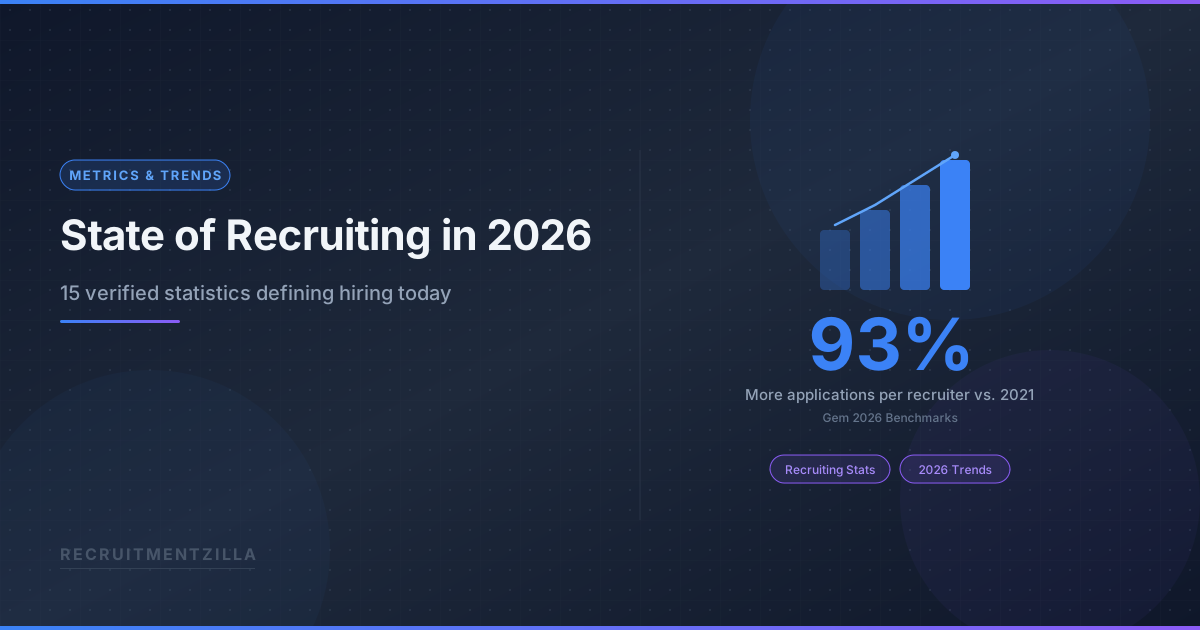
Recruiters now manage 93% more applications and 40% more open roles than in 2021. Yet hires per recruiter have dropped 43% (Gem 2026 Recruiting Benchmarks, 2026). That paradox defines the state of recruiting in 2026.
If you’re a TA leader searching for a vendor-neutral, data-grounded snapshot of the state of recruiting right now, this article compiles 15 verified statistics from Tier 1 and Tier 2 sources. We’ve pulled data from the Bureau of Labor Statistics, SHRM, Gartner, NACE, Gem, and Korn Ferry to quantify the shifts across workload, AI maturity, sourcing effectiveness, candidate behavior, and workforce strategy. No proprietary spin. Just the numbers.
Key Takeaways
- Recruiter workload surged 93% while team sizes shrank 14%
- Only 5% of organizations reach high AI automation maturity
- Internal mobility converts at 32x the inbound applicant rate (Gem, 2026)
- 70% of employers now use skills-based hiring practices
- 76% of TA leaders plan to replace their primary recruiting platform within two years
How Has Recruiter Workload Changed in 2026?
Recruiters handle 93% more applications and manage 40% more open roles than in 2021, while operating with 14% smaller teams, according to Gem’s analysis of 165 million applications and 1.2 million hires (Gem 2026 Recruiting Benchmarks, 2026). The result is a 43% decline in hires per recruiter.
Several forces drive the application surge. AI-generated applications, one-click apply buttons, and mass-apply browser extensions have made it trivially easy for candidates to submit hundreds of applications in a single session. Only 0.5% of applicants now receive offers. That’s one hire per 200 applications.
SHRM’s benchmarking data confirms the pressure from a different angle. Over half of organizations have recruiters managing approximately 20 requisitions each, with executive cost-per-hire climbing 113% since 2017 (SHRM 2025 Recruiting Executives Benchmarking Report, 2025). Time to fill remains around six weeks.
We’ve seen what this looks like on the ground. Managing 13 or more open requisitions simultaneously means context-switching dozens of times daily between sourcing calls, screening interviews, offer negotiations, and hiring manager updates. Quality inevitably suffers when every hour is triaged rather than planned. It’s no surprise that recruiter burnout is accelerating under these conditions.
Meanwhile, 75% of organizations conducted layoffs in 2025, the highest in four years, while expecting remaining staff to absorb the hiring load (GoodTime 2026 Hiring Statistics, 2026). The “do more with less” mandate isn’t a temporary adjustment. It’s structural.
In 2026, recruiters manage 93% more applications and 40% more open roles than in 2021 while teams are 14% smaller, resulting in a 43% drop in hires per recruiter according to Gem’s analysis of 165 million applications.
What Role Is AI Playing in Recruiting Right Now?
While 84% of talent leaders plan to use AI and 99.8% of TA teams claim some form of involvement, only 5% of organizations have reached high automation maturity (Phenom AI & Automation Maturity Report, 2025). The gap between aspiration and execution is enormous.
The ambition is real. According to Korn Ferry’s survey of 1,600 talent leaders, 52% plan to add autonomous AI agents to their teams in 2026 (Korn Ferry TA Trends 2026, 2025). GoodTime reports that 99.8% of TA teams use, pilot, or plan to use AI agents (GoodTime, 2026). Those numbers sound transformative.
But what does maturity actually look like? Not like those headline figures suggest. Of nearly 500 organizations evaluated by Phenom, 83% scored at low maturity levels (1.5 to 2.5 on a 4-point scale). Most teams use AI for isolated tasks: resume parsing, interview scheduling, basic candidate communication. True process automation remains rare.
Gartner’s Jamie Kohn puts it bluntly: “We have started to see some companies rehiring for roles they thought AI could do.” By 2027, Gartner predicts 75% of hiring processes will include certifications and tests for workplace AI proficiency (Gartner TA Trends 2026, 2025).
The Gap Between AI Aspiration and AI Execution
Why the disconnect? Leadership readiness is one factor. Only 22% of companies believe their leaders can effectively manage mixed human-AI teams (Korn Ferry, 2025). You can’t scale AI adoption when the people overseeing it don’t understand what it does or doesn’t do well.
Josh Bersin’s research offers a counterpoint. When organizations do implement AI-enabled recruiting properly, they see 2-3x faster time to hire and stronger candidate-role matches (Josh Bersin, 2025). The technology works. The organizational readiness doesn’t.
So where does that leave practitioners? If you’re evaluating how AI matching platforms actually work in practice, the honest answer is: it depends entirely on your maturity level and your team’s capacity to manage the tools.
Despite 84% of talent leaders planning to use AI in 2026, only 5% of organizations have achieved high automation maturity, revealing a significant gap between AI aspiration and execution in recruiting.
Which Sourcing Channels Deliver the Best Results?
Internal mobility candidates convert at 32x the rate of inbound applicants, making them the highest-yield source channel by a wide margin (Gem 2026 Recruiting Benchmarks, 2026). Referrals follow at 11x, and sourced candidates at 8x.
The hierarchy is clear. Direct sourcing delivers 11% of hires from just 2.6% of applications, a 4x yield compared to inbound. But the most striking shift is in rediscovered candidates. In 2026, 46% of sourced hires come from candidates already in the database, up from 26% in 2021. According to Recruiterflow, 63% of all placements now originate from existing candidate data (Recruiterflow, 2026).
What does this mean practically? Your ATS is sitting on a gold mine. We’ve found that the highest-performing recruiters spend 30 minutes each morning mining their existing database before opening any new sourcing tool. They tag silver medalists from prior searches, set re-engagement triggers, and build “warm” pipelines that don’t depend on fresh outreach. When 46% of successful hires are people you’ve already spoken to, the ROI on rediscovery workflows is hard to ignore.
Referrals remain the second-best channel. If you’re interested in building a referral program that delivers 11x conversion, the data makes the business case clear. The offer acceptance rate across all channels hit 82% in 2026, the highest since 2021, suggesting that when recruiters do connect with the right candidates, those candidates are saying yes.
Internal mobility converts at 32x the rate of inbound applicants, referrals at 11x, and sourced candidates at 8x, according to Gem’s 2026 benchmarks covering 1.2 million hires.
How Is the Labor Market Shaping Hiring in 2026?
BLS JOLTS data for February 2026 shows the hiring rate at 3.1%, the lowest since April 2020 pandemic shutdowns, with hires down 387,000 year-over-year (Bureau of Labor Statistics JOLTS, 2026). This isn’t a dip. It’s a structural slowdown.
Job openings held relatively stable at 6.9 million, suggesting employers aren’t closing positions. They’re simply not filling them. Total hires fell to 4.8 million in February while total separations reached 5.0 million. For the first time in this cycle, more people are leaving jobs than starting new ones.
SHRM frames the current state of recruiting as a “low hire, low fire” environment. Johnny Campbell, CEO of SocialTalent, calls it structural rather than temporary (SHRM, 2026). Companies aren’t panicking. They’re waiting. And that waiting has consequences for both sides.
On the candidate side, iCIMS reports that 45% of workers plan to search for new roles in 2026, up from 42% the prior year (iCIMS January 2026 Workforce Report, 2026). Yet 31% say changing jobs feels too risky. People want to move but won’t, creating pent-up demand that could shift quickly if conditions change.
Here’s the uncomfortable truth for TA teams: only 31% of recruiting teams use labor market data to inform their talent strategy (Gartner, 2026). Most teams fly blind on macro trends while complaining about outcomes. For optimization strategies for teams navigating reduced hiring velocity, labor market literacy is table stakes.
The U.S. hiring rate fell to 3.1% in February 2026, the lowest since April 2020, while total separations exceeded hires for the first time, signaling a structural shift in labor market dynamics.
What Does the Rise of Skills-Based Hiring Mean for Recruiters?
Seventy percent of employers now use skills-based hiring practices, up from 65% the prior year, while GPA screening has nearly halved from 73% in 2019 to 42% today (NACE Job Outlook 2026 Survey, 2025). The credential-to-skills shift is no longer theoretical.
NACE’s survey of 183 employers reveals that 71% use skills-based approaches at least half the time. Skills assessments appear most frequently during interviewing (87%) and screening (65%). The traditional funnel of resume, degree verification, then interview is inverting toward assess, then verify, then decide.
What skills matter most? Korn Ferry’s survey of 1,600 talent leaders ranks critical thinking as the number one recruiting priority. AI skills rank only fifth (Korn Ferry, 2025). That’s a surprising finding given the AI hype cycle. Employers want people who can think clearly about complex problems, not just people who can prompt a chatbot.
The looming risk is skill scarcity. Gartner predicts that by 2030, half of enterprises will face irreversible skill shortages (Gartner, 2025). “Irreversible” is a strong word from a firm known for measured language. It means the window for building skill pipelines is closing.
There’s a disconnect on the candidate side too. Fewer than 40% of graduates are even familiar with the term “skills-based hiring.” If you’re implementing this approach, your complete guide to implementing skills-based hiring should include candidate education as part of the rollout. Otherwise you’ll assess candidates who don’t understand the process they’re in.
Skills-based hiring has reached 70% employer adoption while GPA screening dropped from 73% to 42% since 2019, marking a fundamental shift in how organizations evaluate talent.
How Are Candidates Responding to the 2026 Job Market?
Only 7% of candidates believe the current job market favors them, while 72% report that the job they applied for turned out different from what was advertised (Greenhouse 2025 Workforce & Hiring Report, 2025). Frustration runs deep on both sides of the hiring table.
Candidates are fighting back, sometimes dishonestly. Greenhouse found that 28% of job seekers admit using AI to generate fake work samples. Another 32% have claimed AI skills they don’t actually possess. Meanwhile, 45% use AI to prepare for interviews and 22% use bots to mass-apply (Greenhouse, 2025). GoodTime identifies fraudulent and AI-generated candidates as the number one anticipated threat for 2026 (GoodTime, 2026).
But let’s be honest about something. Employers who express outrage at candidate fraud should look in the mirror. When 72% of candidates say the advertised job differed from reality, that’s employer-side deception at scale. The trust crisis cuts both ways. Candidates who’ve been burned by misleading postings feel justified in gaming the system. That doesn’t make it right, but it makes it predictable.
Trust has eroded measurably. Forty-six percent of candidates say trust in hiring has decreased. And 31% say changing jobs feels too risky (iCIMS, 2026). You can’t build a talent strategy on a foundation of mutual suspicion. For practical approaches to balancing automation with candidate trust, transparency must come first.
The AI Arms Race Between Candidates and Employers
Gartner predicts that 75% of hiring processes will include AI proficiency tests by 2027 (Gartner, 2025). This is the natural response to candidate AI use: verify what you can’t trust on paper.
Seventy percent of hiring managers say AI helps them make better decisions. But only 8% of job seekers call the process fair (Greenhouse, 2025). That perception gap matters. If candidates believe the system is rigged, they’ll keep gaming it. Expect escalation, not resolution, through 2026 and beyond.
Only 7% of candidates believe the market favors them in 2026, while 28% admit to submitting AI-generated fake work samples, creating an escalating trust crisis on both sides of the hiring process.
What Should TA Leaders Prioritize for the Rest of 2026?
Sixty-seven percent of TA leaders plan to increase recruiting spend in 2026, with 76% expecting to replace their primary recruiting platform within two years (Employ/Jobvite Recruiter Nation 2025, 2025). The investment direction is clear: precision over scale.
Technology replacement tops the priority list. When three-quarters of leaders plan to swap their primary platform, it signals widespread dissatisfaction with current tools. The next priorities are AI agent deployment (52%) and internal mobility infrastructure. Given that internal mobility converts at 32x and 46% of sourced hires come from rediscovered candidates (Gem, 2026), the ROI case for internal talent systems is strong.
Gartner outlines four TA trends for 2026: AI-first high-volume hiring, recruiter upskilling for complex work, early-career pipeline redesign, and talent assessment overhaul. Phenom’s data suggests one-third of recruiting capacity will shift toward internal talent mobility in the near term.
But readiness remains the bottleneck. Only 22% of companies are planning leadership succession with AI readiness in mind (Korn Ferry, 2025). You can’t deploy AI agents when your leaders don’t understand what those agents do.
One regulatory consideration: the EU AI Act takes effect in August 2026. All AI used in recruitment will be classified as high-risk, requiring documentation and bias testing. If you operate in Europe or hire European candidates, compliance preparation should begin now.
For data-backed predictions for recruiting beyond 2026, the trajectory is clear. Precision hiring, skills verification, and internal mobility will define the winners. Scale-first approaches are dead.
Seventy-six percent of TA leaders expect to replace their primary recruiting platform within two years, signaling an industry-wide shift toward AI-native, flexible systems built for precision hiring.
Frequently Asked Questions
What is the average cost per hire in 2026?
SHRM benchmarks show executive cost-per-hire has risen 113% since 2017 and 21% since 2022, with time to fill remaining approximately six weeks (SHRM, 2025). The figure varies by role level, but executive hires average $35,000 or more. Non-executive roles fall lower, though rising application volumes increase screening costs across all levels.
How many applications does the average recruiter handle in 2026?
Recruiters manage 93% more applications than in 2021 with 14% smaller teams, processing roughly 13.4 open roles per recruiter simultaneously (Gem, 2026). Over half of organizations now have each recruiter managing approximately 20 requisitions. The volume surge comes largely from AI-powered mass-apply tools.
What percentage of companies use AI in recruiting?
According to GoodTime, 99.8% of TA teams use, pilot, or plan to use AI agents (GoodTime, 2026). Korn Ferry reports 84% of talent leaders plan to use AI actively in 2026. However, Phenom finds only 5% have achieved high automation maturity. Most remain at task-level automation for scheduling and parsing.
Is skills-based hiring replacing degree requirements?
Yes, measurably so. Seventy percent of employers now use skills-based hiring while GPA screening fell from 73% to 42% since 2019 (NACE, 2025). Skills assessments are used most during interviewing (87%) and screening (65%). However, fewer than 40% of graduates understand what skills-based hiring means, creating a communication gap.
What is the best source of hire in 2026?
Internal mobility converts at 32x the rate of inbound applicants, followed by referrals at 11x and sourced candidates at 8x (Gem, 2026). Additionally, 46% of sourced hires come from rediscovered candidates already in the database. If you want to learn how to measure quality of hire across these channels, conversion rate alone doesn’t tell the full story.
Conclusion
So what’s the real state of recruiting in 2026? It’s defined by five tensions. Volume versus quality: 93% more applications, 43% fewer hires. AI aspiration versus execution: 84% plan to use AI, 5% have matured. Employer caution versus candidate skepticism: 3.1% hiring rate meets 7% candidate confidence. Credential tradition versus skills reality: GPA screening halved while skills-based hiring reached 70%. Scale versus precision: the winners are investing in internal mobility (32x conversion) and rediscovery (46% of sourced hires).
These statistics on the state of recruiting point in one direction. The teams that will outperform aren’t hiring more. They’re hiring better, from sources they already have, using assessments that verify what candidates can actually do. Audit your own funnel against Gem’s benchmarks. If your internal mobility rate is below average, start there. That’s where the math is most favorable.